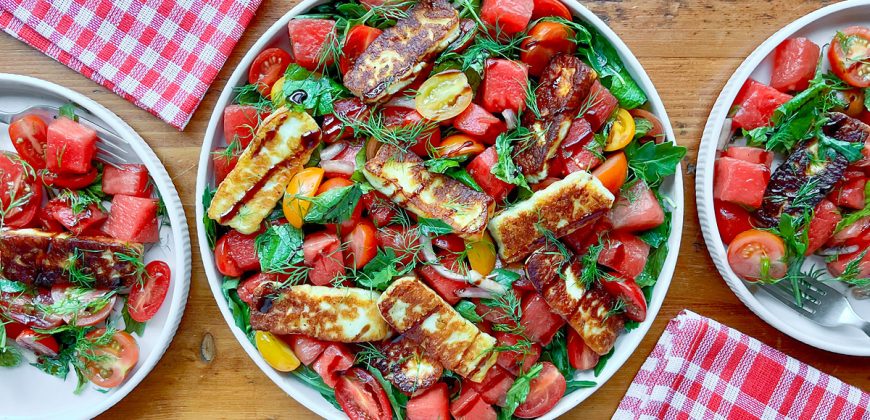
This watermelon tomato halloumi salad recipe makes a refreshing summer salad from Cyprus which you’ll come across in many iterations across the Mediterranean. Aside from being incredibly delicious and cooling, this light yet filling salad comes together quickly, is super versatile, and can be eaten on its own or as a fantastic side to fish or seafood, roast chicken or barbecued meats.
You’ll love this recipe for a watermelon tomato halloumi salad from the Mediterranean island of Cyprus, if you’re a fan of the fruit and cheese combination in salads and starters – the best representation of that match being the Caprese salad of buffalo mozzarella, tomatoes and basil, from another Mediterranean island, that of Capri, off the coast of Southern Italy.
I know some baulk at combining tomatoes and watermelon, but tomatoes are a fruit, after all. Both are juicy fruits, but while cherry tomatoes burst in the mouth, chilled watermelon pieces melt deliciously, especially on a sweltering day. The salty chewy slices of pan-fried halloumi provide a wonderful contrast of texture and flavours, while the red onion or purple shallots bring crunch and bite, and the herbs give fragrance and freshness.
You could serve this watermelon tomato halloumi salad with gently spiced Cypriot meatballs for Cyprus-style keftedes – or any barbecued or grilled meats, such as smoky char-grilled chicken skewers for Greek souvlaki with the Greek cucumber and yoghurt dip, tzatziki. For a proper Mediterranean feast, start with meze such as homemade taramosalata and a Greek red pepper feta dip, and make a couple more salads, such as this Cypriot village salad, a classic Greek salad or Greek blistered cherry tomatoes on goats cheese.
This watermelon tomato halloumi salad recipe is first up in a series of recipes for the salads I’ve had on rotation here in Australia in recent months, including this Italian melon, buffalo mozzarella and prosciutto salad (a fancier version of prosciutto e melone, the classic aperitivo snack and appetiser from Italy), this refreshing Greek watermelon feta salad with fresh mint and dill, and a Mediterranean style chicken salad with spring vegetables and a garlicky lemony Middle Eastern dressing.
Before I tell you more about this watermelon tomato halloumi salad recipe, I have a favour to ask. Grantourismo is reader-supported. If you’ve cooked and enjoyed our recipes, please consider supporting Grantourismo. For instance, you could buy something on Amazon, using our links, such as classic cookbooks for serious cooks or cookbooks for culinary travellers; book a cooking class or meal with locals on EatWith; or buy a handcrafted KROK, the best mortar and pestle ever, made by artisans in Thailand.
And if you’re looking for more cooking inspiration, we have many hundreds of recipes from around the world in our archives from places we’ve lived, worked and travelled. Note that you can save your favourites by clicking on the heart on the right of any post to create your own private account. Now let me tell you more about this watermelon tomato halloumi salad recipe.
Watermelon Tomato Halloumi Salad Recipe from Cyprus
Travel around the sun-kissed island of Cyprus – which lies around 60 kms south of the coast of Turkey and 100 kms west of Syria and Lebanon – and you’ll spot variations of this watermelon tomato halloumi salad on menus and tables during the long hot summer, when watermelons and tomatoes are in season – along with village salads with tomato, cucumber and capsicum, and a tomato feta salad like the classic Greek feta salad.
We used to get to Cyprus for short breaks when Terence and I lived in the United Arab Emirates. Cyprus was an easy Middle Eastern getaway, just a 4-hour flight from Abu Dhabi and Dubai, most nationalities don’t need tourist visas for Cyprus, and you can get through Larnaca airport and be in your hire car in just half an hour – provided you have an international driving permit, but that’s another story!
On our last trip to Cyprus, we crisscrossed the island in a rental car, researching a Cyprus travel guidebook and working on magazine stories – everything from hotel and restaurant reviews to a feature story on Cyprus’ first eco-tourism village, which was memorable. At the end of that journey, having put dots on maps for every city, town and village of any interest to travellers, I left feeling like I knew Cyprus intimately, with a new fondness for the island.
That first edition Cyprus guide was only my second solo guidebook writing effort after co-authoring loads of Lonely Planet guidebooks with Terence. My first solo guidebook gig was a first edition DK Top 10 Dubai and Abu Dhabi book that Terence photographed and I planned, researched and wrote soon after leaving my Dubai job. I came across both guides while recently sorting through a suitcase heaving with our published books at mum’s house, and I have to admit I’m still proud of those two little guidebooks.
I researched and wrote the Cyprus guidebook by myself because Terence was shooting images for the book and stories we were doing, as well as doing all the driving, which can be taxing in itself on a long trip While the driving on Cyprus is generally easy on most of the island’s excellent roads, it could be challenging in the High Troodos Mountains.
At times we were driving on twisting tracks that were so narrow another car couldn’t pass. But the route is so breathtakingly beautiful, beneath shaded tree canopies, overlooking deep forested valleys – of Palestine and Aleppo oaks, Phoenician juniper, Calabrian pine, Anatolian black pine, and Cyprus cedar – that you want to take it slowly so you can take in the gobsmacking views and scents. I’ll never forget the fresh heady perfume of pine wafting from the forest.

As spectacular as the scenery is – in spring the mountains are ablaze with wildflowers and in winter, at the highest altitude, around the summit of Mount Olympus, which at 1,952 metres (6,404 ft) is the highest point in Cyprus, the slopes are blanketed in snow, when tyre chains are needed – driving those serpentine mountain tracks can take its toll after a while.
Cyprus is the third largest Mediterranean island after Sicily and Sardinia, and the Troodos Mountain range is massive, covering half the island. Unfortunately a great deal of old-growth forest was cleared over time, for timber for shipbuilding, for agriculture and crop terraces, and to establish fresh grasslands for goats.
In the 19th century Cyprus’ goat population was the largest of any Mediterranean islands. While the loss of forest is a tragedy, we have those goats to thank for the centuries old cheese, halloumi, which is thought to have originated on Cyprus, from where it travelled to Lebanon and the Levant and throughout the Middle East and Mediterranean.
First documented in Cyprus in 1556, halloumi is now the national cheese of Cyprus, made from both goat milk and sheep milk in small rustic cheese dairies and state of the art factories all over Cyprus. Halloumi is the second largest export product of Cyprus and is protected by geographical indication in the European Union as a Protected Designation of Origin, meaning that within the EU only products made in certain in Cyprus can be legally named ‘halloumi’.
While halloumi (in Greek-Cyprus) or hellim (in Turkish-Cyprus) is a key ingredient in the Cypriot diet – and in this watermelon tomato halloumi salad – halloumi is also a significant part of Cypriot culinary heritage, and an essential element of the Cypriot cultural identity. Goat herding and artisanal cheese making (mostly by women) have long been central to traditional village life, bringing communities together for centuries.
I’ll tell you more about halloumi in another post. Just a few tips to making this watermelon tomato halloumi salad recipe, as it’s super easy and comes together quickly.

Tips to Making this Watermelon Tomato Halloumi Salad Recipe from Cyprus
I only have a few tips to making this refreshing watermelon tomato halloumi salad recipe, as it’s a cinch to make and so incredibly delicious, however you assemble it.
Watermelon
Use a traditional pink watermelon as it’s not only pretty in this salad, but the pink hue comes from lycopene, which is an antioxidant so it’s good for you. Yellow watermelons do not contain lycopene. I prefer to cut the watermelon into cubes roughly the same size as the cherry tomatoes or tomato pieces, but I spotted triangular wedges of watermelon in Cyprus, which looked striking.
Tomatoes
Along with vine-ripened cherry tomatoes, chopped whole tomatoes typically share the plate with the sweetest watermelon, zingy red onions, and a mix of fresh herbs. But you could use truss tomatoes or Roma tomatoes, or a medley of cherry tomatoes as I’ve done.
Halloumi
It should go without saying that you’ll want to use Cypriot halloumi for this watermelon tomato halloumi salad recipe. As halloumi is Cyprus’ second most important export product, you should have no problem finding it!
Herbs
I adore fresh mint and fresh dill, but the mix of fresh herbs might include fresh flat-leaf parsley and/or basil or whatever the cook has plucked from the kitchen garden or their own garden, or picked up at the morning market on their drive to work.
Roca Leaves
I’ve assembled the salad on a base of roca leaves – or rucola, rocket or arugula, depending on where you’re from. But I’ve also spotted this salad served atop a mix of lettuce leaves. Cyprus grows a mind-boggling array of lettuce varieties – along with cabbages, cucumbers, carrots, eggplants, capsicums or bell peppers, and an abundance of herbs.
I’ve also seen watermelon, tomato and halloumi salads served without any greens – like its Greek cousin, which consists of little more than watermelon, feta, red onion, and fresh mint and basil. A warning: in the Greek watermelon and feta salad, sometimes the watermelon is soaked in ouzo, so don’t be surprised if you find yourself snoozing on the beach after lunch.
Salad Dressing
All your dressing needs is extra virgin olive oil and balsamic vinegar (use the best quality of both that you can source and afford), but I also love to drizzle a little balsamic glaze on at the end. Some Cypriot cooks use honey. Cypriot honey of course.
To Serve
Chill the salad in the fridge until you’re ready to eat then toss the salad into a big bowl or assemble it onto a platter. Piled onto a dazzling white plate, the refreshing chilled salad is even more enticing when set down onto a wooden table by the seaside.
Especially if you’re sitting in the scorching sun, perspiration beading on your sunburnt skin, and sweat dripping from your brow onto the butchers paper that serves as a tablecloth. Speaking from experience here!
Watermelon Tomato Halloumi Salad Recipe from Cyprus

Ingredients
- 2 tbsp olive oil - Mediterranean style, more if needed
- 220 g halloumi - cut into 10 slices, preferably Cyprus style
- 1 cup rucola leaves - baby, or small
- 1 purple shallot - sliced, or half red onion
- 300 g watermelon - cut 2cm cubes, seedless or seeds removed
- 300 g cherry tomatoes - mix of colours, sliced in half
- ½ cup fresh mint leaves - loosely packed cup
- ½ cup fresh dill - loosely packed cup
- 1 tbsp extra virgin olive oil - more if needed
- 1 tsp balsamic vinegar
- 1 tsp balsamic glaze - optional
Instructions
- In a large pan over medium, heat the olive oil until shimmering. Place the halloumi slices in the pan in a circle, clockwise (taking care not to burn yourself), leaving them to fry for a minute until golden brown.
- Use tongs to start to turn the halloumi slices over, starting from where you left off. The second side cooks faster than the first, so by the time you come full circle, the first slice should be done. Remove the pan from the heat and transfer the slices to a plate to cool.
- In a large salad bowl, toss the baby rucola leaves, purple shallot or red onion slices, watermelon cubes, cherry tomato halves, fresh mint leaves, fresh dill, extra virgin olive oil, and balsamic vinegar.
- Transfer the salad to serving plate, lay the pan-fried halloumi slices on top, and, if you like, drizzle a little balsamic glaze on top, or serve as is with Turkish bread or crusty sourdough.
Please do let us know if you make this refreshing watermelon tomato halloumi salad recipe, as we’d love to know how it turns out for you, and always welcome feedback, tips and recipe ratings.