This easy tzatziki recipe makes an authentic creamy Greek yoghurt cucumber dip that has cousins in other Mediterranean cuisines, from Turkish cuisine to the cuisines of the Levant of Lebanon, Syria, Jordan and Palestine, and Indian cuisine. Traditionally served as a meze and eaten as a dip with pita, tzatziki is also served as a side and sauce with souvlaki and other grilled meats.
If you love the food of the Mediterranean, such as meze or mezze – the snacks and dips that serve as drinking food and starters kick off a meal and are a highlight of the cuisines of the Middle East and Southern Europe – you’re going to love this easy tzatziki recipe for an authentic creamy Greek yoghurt cucumber dip. It’s one of our best Greek recipes. Homemade tzatziki is so much more delicious than store-bought.
Cucumber and yoghurt are another one of those great ingredient combinations – like melon and prosciutto and tomato and buffalo mozzarella – and you’ll also find that cucumber and yoghurt combo in Arabic mezze in khyar bi laban and in Indian cuisine, in raita. Like those quintessential Italian appetisers, this simple meze is an iconic Greek dish that’s so intrinsic to the culinary culture it’s hard to imagine Greek cuisine without it.
Tzatziki is to Greek food what hummus is to Middle Eastern food, gastronomically and culturally. Both are beloved specialties. You can dip pita into tzatziki, just as Arabic flatbreads are used to scoop up hummus. Eat tzatziki alongside dips like taramosalata, a Greek salad, Greek meatballs and souvlaki. You can also argue about its components, how it’s made, its origin and ‘authenticity’. (She says with a wink!)
Now let me tell you a little about this tzatziki recipe – or you can click on the button above to jump straight to the recipe.
Tzatziki Recipe for an Easy Authentic Greek Yoghurt Cucumber Dip
As far as we’re concerned, the best Greek food is made in one of our favourite parts of Greece, which probably isn’t where you think – it’s not an idyllic Aegean island surrounded by turquoise waters nor the ruggedly beautiful Peloponnese, our next favourite part of Greece. It’s in and around Thessaloniki or Saloniki, a lively port city in northern Greece with a unique gastronomy thanks to its rich history and location at a culinary crossroads.
Thessaloniki is the capital of modern Greek Macedonia, which encompasses a quarter of Greece, and is located just south of the old capital of the ancient Kingdom of Macedonia. According to classical Greek historian (and travel writer!) Herodotus, the Macedonian Kings were descendants of Heracles and had a direct lineage to Zeus, the greatest god of the Greek pantheon. For a while, the small kingdom was also one of the world’s greatest empires.
Along with the Balkans and the lands around the Black Sea – parts of modern day Bulgaria, Romania, Ukraine, and Russia – the ancient Kingdom of Macedonia was a vassal state of the Persian Achaemenid Empire for a short time, which would have left a mark on the culture. There was much intermarriage between the Persians and Macedonians. However, a greater cultural exchange would occur a century or so later.
The best-known Macedonians were Aristotle and Ancient Macedonia’s most powerful king, Alexander the Great, whose empire included mainland Greece, Asia Minor, the Levant, Egypt, Mesopotamia, Persia, and a huge swathe of Central and South Asia. Travel to those countries today and you’ll see Alexander’s blue-eyed descendants. (Apparently Alexander had one blue eye and one brown.)
Ancient Macedonians produced wine (there are many wineries around Thessaloniki), raised and ate goats and cows, incorporated meat into dessert (if you’ve been to Istanbul you’d recall chicken pudding), held banquets called symposiums featuring lavish feasts, drinking, philosophical discussion, and entertainment, according to Andrew Dalby in Siren Feasts: a History of Food and Gastronomy in Greece.
Dalby writes that one of the best known dishes of Ancient Macedonia was mattye, a stew of spiced chicken or other meat with fried pasta served during the wine course. But more importantly for our tzatziki story, the ancient Macedonians were the first to use flat bread as a vehicle for meat in the 3rd century BC. In ancient times tzatziki was called mittiko (μυττικό), and was served as a sauce with meats on pita bread, and the recipes are practically same.

It was in Thessaloniki that we had some of our most memorable meals and ate the best Greek mezedes – the small plates served as drinking food, snacks, dips, starters, and sides to main dishes, especially grilled meats, eaten with flatbread.
It was in backstreet ouzeris that rarely saw foreigners, where we’d enjoy leisurely lunches and settle in for an evening, grazing on mezedes while we watched musicians perform. One of the mezedes was tzatziki.
But tzatziki tastes the same everywhere, you’re probably thinking. No, it doesn’t. You only have to ask a Greek for their mother’s tzatziki recipe, or at the very least what it was comprised of, what was the consistency, was it thick or thin, and whether it was sprinkled with dried or fresh oregano, thyme, mint, or dill, or served without any garnish.
Some will argue that tzatziki doesn’t have dill. It certainly does in some parts of Greece. Especially in around Thessaloniki, where dill features in many local specialties, such as a fragrant herb omelette that includes fresh dill, stuffed vegetables filled with dried fruits, dill and other herbs, a wonderful dish of mussels with lemon rice and dill, and a lamb broth brimming with wild greens including dill.
Our tzatziki recipe will make you the style of tzatziki we became smitten with in Thessaloniki: incredibly rich, thick and creamy, thanks to full-fat whole-milk Greek yoghurt that’s strained, made with grated cucumber for a silky texture and top quality Greek extra virgin olive oil, and perfumed with fragrant dill that permeates the dip as well as serves as a garnish.
Just a few tips to making this easy tzatziki recipe, as it couldn’t be more simple to make.

Tips to Making this Easy Tzatziki Recipe for an Authentic Greek Yoghurt Cucumber Dip
I only have a few tips to making this easy Greek tzatziki recipe as it’s a cinch to make and comes together quickly. Firstly, peel the cucumber if it has a tough skin. I’m currently using incredibly delicious Persian cucumbers with the thinnest of skins, so I’m not peeling them. But a few weeks ago, I could only source English cucumbers with thick bitter skins.
Slice the cucumber in half lengthways and use a teaspoon to scrape out the seeds if they don’t taste great. Once again, the tiny seeds and juices of these Persian cucumbers are absolutely delicious, so if I was making an Arabic cucumber yoghurt dip I’d leave them in, but with tzatziki you want to reduce the water content, so you want them out.
I recommend using a box grater to grate the cucumber, then wrap that grated cucumber in a light cloth such as muslin or paper kitchen towels, and squeeze the grated cucumber to remove any excess water.
Add the grated cucumber, creamy Greek yogurt, minced garlic, white wine vinegar, and extra virgin olive oil to a bowl and stir everything vigorously to combine it all, then cover and refrigerate the tzatziki until you’re ready to serve it.
Just before you’re ready to serve it, add most of the fresh dill to the tzatziki except a little to sprinkle on top, and stir to incorporate the aromatic herbs. Transfer the tzatziki to a serving bowl.
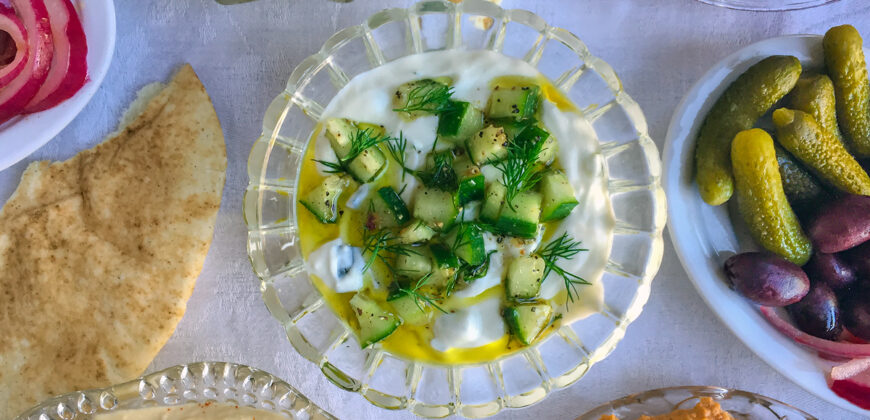
Sprinkle a teaspoon of finely diced cucumber and a little chopped fresh dill on top of the tzatziki, drizzle on a little extra virgin olive oil, and grind some cracked black pepper on top and serve immediately with pita or crusty bread, a great Greek salad, and grilled seafood or Greek meatballs. Enjoy!
Tzatziki Recipe for an Easy Authentic Greek Yoghurt Cucumber Dip

Equipment

Ingredients
- 300 g Greek yogurt - full fat, otherwise strain to thicken
- 100 g cucumber
- 1 garlic clove - peeled, minced
- 1 tsp white wine vinegar
- 2 tbsp extra virgin olive oil - preferably Greek
- 2 tbsp dill - fresh, roughly chopped, divided
- ¼ tsp sea salt - or to taste, optional
Instructions
- Peel the cucumber, slice it in half lengthways and use a teaspoon to scrape out the seeds; use a box grater to grate the cucumber; and wrap the grated cucumber in a light cloth such as muslin or paper kitchen towels, and squeeze the grated cucumber to remove excess water.
- To a bowl, add the yogurt, shredded cucumber, minced garlic, white wine vinegar, and extra virgin olive oil, stir vigorously to combine everything, and refrigerate until you’re ready to serve.
- Just before serving, add a tablespoon of chopped fresh dill to the tzatziki, and stir to incorporate. Taste, and add more dill if you like. Transfer the tzatziki to a serving bowl.
- Garnish with the finely diced cucumber, sprinkle the rest of the fresh dill on top, and drizzle on a little extra virgin olive oil. Not traditional, but if you like, grind some cracked black pepper on top and serve.
Notes
Nutrition
Please do let us know if you make our Greek tzatziki recipe as we’d love to know what you think.