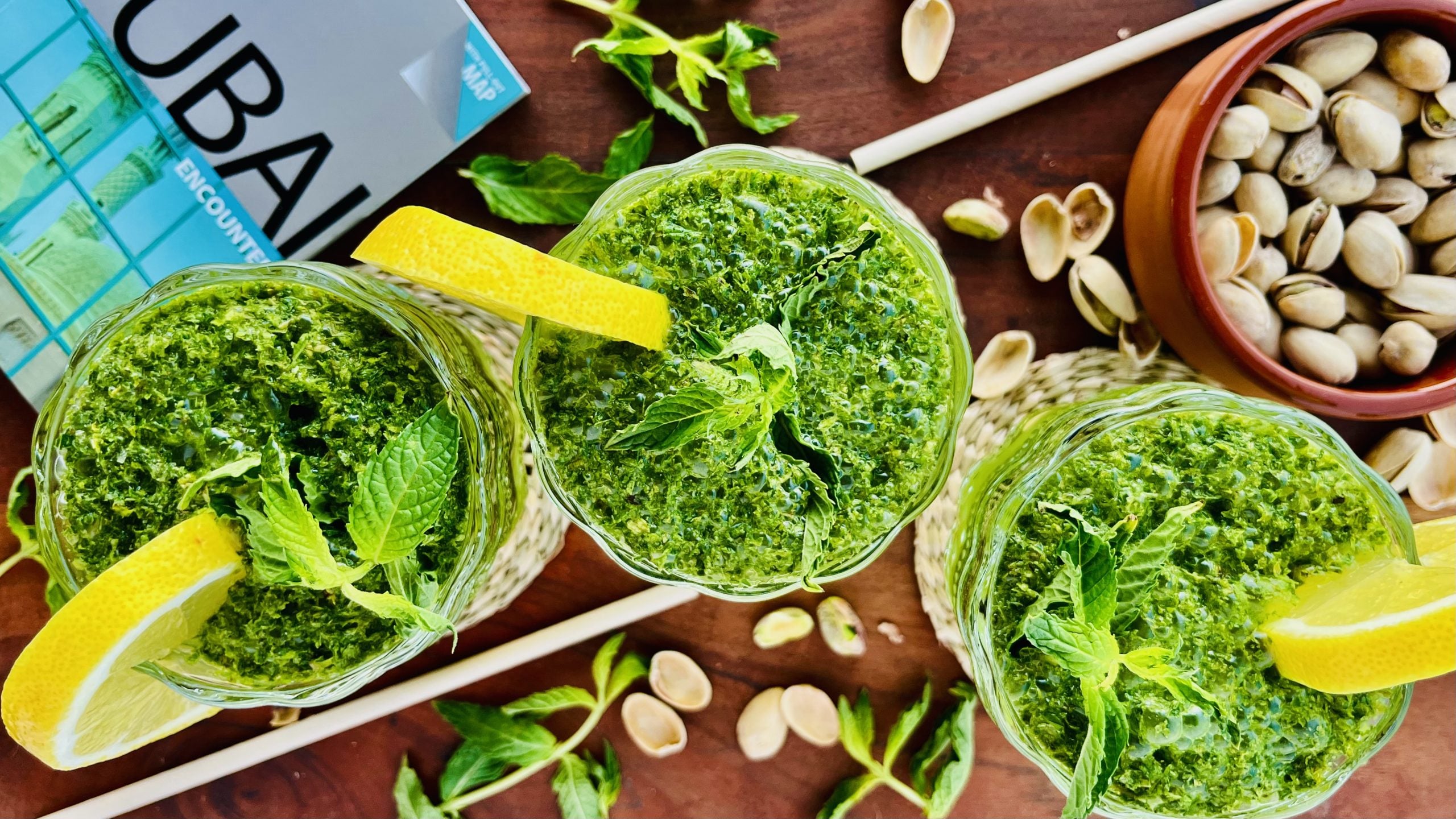
This Middle Eastern mint lemonade recipe makes a refreshing drink of lime juice, lemon juice and fresh mint that has floral notes courtesy of orange blossom water. Dating to medieval times, in Arabic this mint lemonade is called limon na’naa, limonana or limonada, depending where you are. It’s popular everywhere from Egypt to the Levant, Iran to the Arabian Peninsula — including the UAE, where we lived and first tasted this fragrant citrusy beverage. I’ve been making it ever since.
You’ll love this Middle Eastern mint lemonade recipe if you’re fond of fresh aromatic mint, the most perfumed of citrus fruits that are lemon and lime (the ‘limon’ in the name), and you much prefer to make pitchers of homemade refreshments to serve your guests, or enjoy yourself over a leisurely weekend at home.
After we moved to the United Arab Emirates capital Abu Dhabi way back in 1998, I established weekend rituals; the best thing expats can do to quickly settle into new places. They included buying a box of mixed baklava from the Syrian bakery on the corner, lighting our Arabian incense burner, preparing a morning pot of Moroccan mint tea to sip with the syrup-soaked pastries, and making mint lemonade in the balmy afternoon.
Because it was in the UAE, in Dubai, that I first tasted this Middle Eastern mint lemonade. Terence and I had been eating Middle Eastern food for years — mainly Lebanese, Turkish and Moroccan food — but we hadn’t come across this thirst-quenching drink before moving to the MidEast. I became instantly smitten and have been making it ever since. Try our Middle Eastern mint lemonade recipe, but tweak as you see fit; it’s endlessly versatile.
Now before I tell you more about this Middle Eastern mint lemonade recipe, I have a favour to ask. Grantourismo is reader-supported. If you’ve enjoyed our recipes, please consider supporting Grantourismo. You could buy a handcrafted KROK, the best mortar and pestle ever; book a cooking class or meal with locals on EatWith; or buy something on Amazon, such as a cookbook for culinary travellers or classic cookbook for serious cooks.
Looking for more inspiration? We’ve got thousands of recipes in our archives from around the world from places we’ve lived, worked, travelled, and loved. And note that you can save your favourites in a private account by clicking on the heart on the right of posts. Now let me tell you more about this Middle Eastern mint lemonade recipe.
Middle Eastern Mint Lemonade Recipe for Limon na’naa and Limonana
I’ve been making this Middle Eastern mint lemonade recipe for almost 30 years, since we first moved to Abu Dhabi, where I’d been hired to teach writing and media production to young Emirati women, and start a filmmaking programme — well before we became Lonely Planet guidebook authors. I loved my job; it was groundbreaking work. My students weren’t only the UAE’s first women filmmakers, they were the UAE’s first filmmakers. They were exciting times.
And we loved the dusty little low-rise capitals that were Abu Dhabi and Dubai, and the adventurous lives and special experiences they gave us, even if they weren’t the most exciting cities back then. Because three decades ago, Abu Dhabi and the UAE’s commercial capital and historic trading port, Dubai, still had a frontier town vibe, and were considered hardship postings by many expats, most of whom were oil workers, nurses and teachers.
Abu Dhabi still had its traditional old souk in the heart of the city on Hamdan Street, which was our street. One or two evenings a week we’d take a sweaty stroll to the sleepy market via the gritty backstreets for our evening walk. Once at the souk, we’d order icy mango juices that were more like mango smoothies, and buy bags of Omani frankincense and small boxes of coal bricks for the incense burner.
Abu Dhabi only had a handful of shopping arcades, most located on the ground floor of hotels and apartment buildings. There was nothing that resembled a shopping centre, so if we needed to do a proper shop, especially in the early days when we were setting up the apartment, we’d hop in a share taxi or hire a car to go to Dubai, which at the time had all of three shopping malls.
This was long before the mega malls, world’s tallest anything, and man-made islands. The sail-shaped Burj al Arab hotel was still under construction, and, like the desolate location of the original Hard Rock Cafe with its two giant crossed guitars, which signalled we were nearing Dubai, was considered to be in the middle of nowhere. Of course that wouldn’t stop expats from testing out the so-called world’s first 7-star hotel.
For those of us who lived and worked in Abu Dhabi and Al Ain, Dubai was an affordable weekend getaway for its beach resorts and, much later, dreamy desert escapes. Tourism was far from booming. The only visitors to the UAE were business travellers and families and friends of expats, so hotels provided heavily-discounted packages to residents.
After The Burj opened, we all thought the interior was tacky and rooms over-priced. Expats preferred to stay at the adjoining wave-shaped Jumeirah Beach Hotel, which offered views of the striking Burj exterior. Although the afternoon tea in the bar at the top of the The Burj became a thing to do for the sweeping views of Dubai’s coastline of white sand beaches and aquamarine sea.
Aside from its three malls, what Dubai also had that Abu Dhabi didn’t was bustling Dubai Creek, with its one dirham abra rides across the water; busy docks lined with traditional wooden dhows that sailed between the UAE and Iran; sprawling atmospheric souks with small shops that sold aromatic spices, spangly textiles and glittering gold; an engaging museum in a handsome centuries-old fort (yes, just one proper museum!); and, a true unpolished hidden gem: a tiny historic quarter called the Bastakiya, which would later be renamed Al Fahidi neighbourhood.
At the time, the Bastakiya quarter was politely described as ‘dilapidated’. Most of its now-splendid restored old windtower buildings were in such a ramshackle state, they were little more than piles of rubble in places. Al Bastakiya’s neglected buildings looked like they’d collapsed in an earthquake; at best, they more closely resembled archaeological ruins than the charming destination the neighbourhood would become with its galleries, cafes and boutique hotels.
The Bastakiya was named after its original residents, Persian merchants from Bastak, across the Gulf, in Hormozgan Province in southern Iran. If you’ve been to Dubai and have been lucky to travel to Bastak and visit one of its grand courtyard buildings, some of which have been exquisitely renovated, you would have recognised the architecture, with its ingenious windtowers. The ancient form of air-conditioning, which would become a symbol of Old Dubai was invented by southern Iranians.
Despite the UAE’s strong Emirati national identity, which would lead everyone to believe all Emiratis were descended from nomadic Arabian tribes, the populations of Dubai and Abu Dhabi are multicultural. And I’m not just talking about the sizeable expat population. Many of my students in Abu Dhabi and Dubai, where we’d later move, had mothers from Egypt, Jordan and India, while others boasted of a “mixed” heritage with roots in places as diverse as Yemen, Palestine and Iran.
I remember one Emirati student, proud of her Persian ancestry, telling me the Dubai dialect, a form of Gulf Arabic called Khaleeji had Farsi loan words and was readily understandable to Iranians. There’s a reason for all those Iranian restaurants in Dubai. Many of Dubai’s most successful families had Persian ancestors who settled in Al Bastakiya in the late 1800s. After they moved into modern villas in the 1970s and 1980s, their neglected Bastaki courtyard residences, built from gypsum, coral and sand, couldn’t withstand the harsh climate when not maintained.
The Dubai government bulldozed half of Al Bastakiya to build the Rulers Court and scheduled demolition of the remaining ruined buildings. It was thanks to British architect Rayner Otter, who’d renovated a courtyard house he called home, that the historic quarter was saved. Otter convinced Prince Charles on a visit to the emirate to persuade Dubai’s ruler Sheikh Maktoum of the merits of preserving the neighbourhood.
When we first visited Dubai Museum in Al Fahidi Fort in 1998, Al Bastakiya was in the midst of a slow transformation that would take some years. Only a small number of windtower residences had been remodelled, the most alluring of which included The Majlis Gallery and Basta Art Cafe.
Located on the edge of Bastakiya on Al Fahidi Street, the breezy Basta Art Cafe had only been opened a year when we stumbled upon it. The shaded courtyard coffee shop was an oasis with its pots of palms and crimson bougainvillea, rattan tables and chairs, and traditional wooden bench seats painted the same turquoise-blue of the dhow boats that plied the Hormoz Strait between Dubai and Bastak.
Stepping into the courtyard was like stepping back in time and it was a wonderful retreat from the heat and glare outside. The arty vibe of both the Majlis Gallery and Basta Art Cafe was also unique for Dubai at the time. Framed watercolours, oils, pen-and-inks, and drawings depicting traditional Arabian scenes hung on the walls, alongside old black and white photographs of early Dubai and the sprawling village of Al Bastakiya that had long gone.
In a nook near the entrance to Basta Art Cafe’s small kitchen, there were shelves holding some of the few books authored by expats at the time, mainly photographic coffee-table tomes, collections of illustrated children’s stories, along with the non-fiction classics that were compulsory reading for all new expats, such as Wilfred Thesiger’s Arabian Sands.
While the Emirati owner was Ali Al Rais, an aviation administrator and world traveller I’d meet some years later when we authored the first Dubai guidebooks for Lonely Planet, the manager I met that first day was the lovely Farah, a Persian name shared with the former Empress of Iran.
When I asked Farah what we should order, without hesitation she suggested one of the big salads popular with regulars — middle-class British expat wives nicknamed ‘Jumeirah Janes’, after the nearby beachside suburb, Jumeirah — and the Basta Special, a thirst-quenching drink of fresh mint and lime juice.
There was a big basket of limes and bunches of fresh mint in glass jars on the counter, so while we gave the salads a miss, we took her recommendation for drinks. And that refreshing minty-lime beverage served in enormous chilled glasses with thick striped paper straws is the drink upon which this Middle Eastern mint lemonade recipe is based.
What I’d later learn while researching the Dubai guidebooks we authored and updated for years is that southern Iran’s Hormozgan province, which is home to Bastak, is famed for its fresh produce, including a bounty of seafood, some of the world’s best dates, and beautiful citrus fruits, especially limes.
And perhaps that explains why this Persian-influenced Middle Eastern mint lemonade was made with lime juice, or, as we sampled the citrus beverage more widely, a combination of lime and lemon juice, rather than the lemon juice-driven lemonades ubiquitous in the rest of the region.
Tips to Making this Middle Eastern Mint Lemonade Recipe
I only have a few tips to making this Middle Eastern mint lemonade recipe, as it’s a quick and easy drink to make, so let’s start with the ingredients.
Ingredients
Our Middle Eastern mint lemonade recipe has just a handful of ingredients.
Lime Juice and Lemon Juice
Although my Middle Eastern mint lemonade recipe is based on the refreshing beverage I fell in love with decades ago after we moved to Dubai, which was made with only lime juice, I do like the combination of both lime juice and lemon juice.
Having said that, I know that many Middle Eastern mint lemonade recipes call for lemon juice only. Please try my Middle Eastern mint lemonade recipe first, but, obviously use whatever fresh citrus fruit you can source.
Water
I use still tap water, as we have safe water here, but by all means use still bottled mineral water. Once made, you can also add a splash of sparkling mineral water or soda water for some effervescence if you like.
Orange Blossom Water
I love to add a teaspoon of orange blossom water for that subtle quintessentially-Middle Eastern taste and aroma. But not everyone enjoys floral flavours, so if you’re not familiar with orange blossom water, go easy the first time.
In Australia, some branches of supermarkets such as Coles and Woolworths sell orange blossom water and rose water in the international groceries aisle, otherwise head to your nearest Middle Eastern supermarket or grocery shop or buy it online.
Sugar
My Middle Eastern mint lemonade recipe calls for just one tablespoon of fine caster sugar, which I dissolve in a little boiling water. That’s plenty of sweetness for my palate, however, I note that some mint lemonade recipes call for a lot more sugar, some for so much sugar the recipe begins with making a sugar syrup.
That’s way too much sugar for my taste, and the original Middle Eastern mint lemonade I became smitten with in the Emirates was not distinguished by its sweetness, but rather its citrusy taste and refreshing, herbaceous minty flavour and fragrance.
But having said that, if you have a sweet tooth and you like the idea of a sweeter lemonade rather than a zingy minty drink, then by all means add more sugar or make a sugar syrup, which is very handy if you’re a cocktail lover.
Ice Cubes
Our Middle Eastern mint lemonade recipe calls for just 2 cups of ice cubes but if you’d like more of a slushy texture, use more ice and blend for longer.
Garnish
Don’t forget to set aside some slices of lemon or lime and some sprigs of fresh mint for garnishing.
Step-By-Step Process
This Middle Eastern mint lemonade recipe is a breeze to make, taking just ten minutes or so.
Squeeze your fresh limes and fresh lemons to extract the juice of each.
Traditionally, the citrus fruit and mint leaves were pounded in a mortar and pestle to make the beverage, but these days a blender will do the trick.
To your blender, add the freshly squeezed lemon juice and lime juice, water, orange blossom water, ice, and fresh mint leaves, and blitz until well-blended. Too easy.
Taste the minty citrus drink and adjust it to suit your palate: for even more of a floral flavour, add a little more orange blossom water, and if you prefer a sweeter drink, dissolve more sugar in a little boiling water and add it to the mix.
Blend the lot again for a few seconds, then taste once more, and adjust if needed.
This recipe will give you the texture of the mint lemonade I fell in love with in Dubai, but if the mint is too fibrous for your liking, blend for longer, use a food processor, or simply scoop off excess.
If it’s still too thick, add a little more water, sparkling mineral water, or even soda water. And if you prefer more of a slushy-like texture, add more ice.
When you’re satisfied, pour the mint lemonade into glasses and garnish with fresh mint sprigs and lemon slices — or lime slices if you prefer.
Not ready to serve yet? Transfer your Middle Eastern mint lemonade to a glass pitcher or jug, cover, and refrigerate until you’re ready to serve. Give it a stir before pouring.
Provide eco-friendly straws or swizzle sticks to guests so they can give their drinks a stir when the mint leaves rise to the surface.
Serve this Middle Eastern mint lemonade with dishes of pistachios or spicy nuts, crunchy pita chips and bowls of hummus — we have lots of hummus recipes here — or Middle Eastern dips such as muhammara and baba ganoush, or a whole array of Arabic mezze and warm flat breads.
And if you enjoy this Middle Eastern mint lemonade, try our rose lemonade recipe or fruity white sangria recipe.
Middle Eastern Mint Lemonade Recipe

Equipment

Ingredients
- 1 cup lime juice -
freshly squeezed from limes
- 1 cup lemon juice - freshly squeezed from lemons
- 1 cup water - and more as needed
- 1 tsp orange blossom water - or more to taste
- 1 tbsp fine caster sugar - dissolved in a little hot water, optional, or more to taste
- 2 cups ice cubes - and more if needed
- 1 cup fresh mint leaves - leaves only, and save some mint leaves for garnishing
- 1 lemon - sliced for garnishing, or lime slices if you prefer
Instructions
- Squeeze your fresh limes and fresh lemons to extract the juice so you have one cup of each (or more if you're adjusting the quantity).
- To a blender, add the lime juice, lemon juice, water, orange blossom water, ice, and fresh mint leaves, and blend.
- Taste and adjust to suit your palate, adding a little more orange blossom water for a more floral flavour, or more sugar dissolved in water if you prefer a sweeter drink, then blend again for a few seconds.
- Pour into glasses — or into a jug and refrigerate until ready to serve — and garnish glasses with fresh mint sprigs and lemon slices — or lime slices.
- Provide eco-friendly straws or swizzle sticks to give the drinks a stir when the mint leaves rise to the surface.
Notes
Nutrition
Please do let us know if you make our Middle Eastern mint lemonade recipe as we’d love to know how it turns out for you.