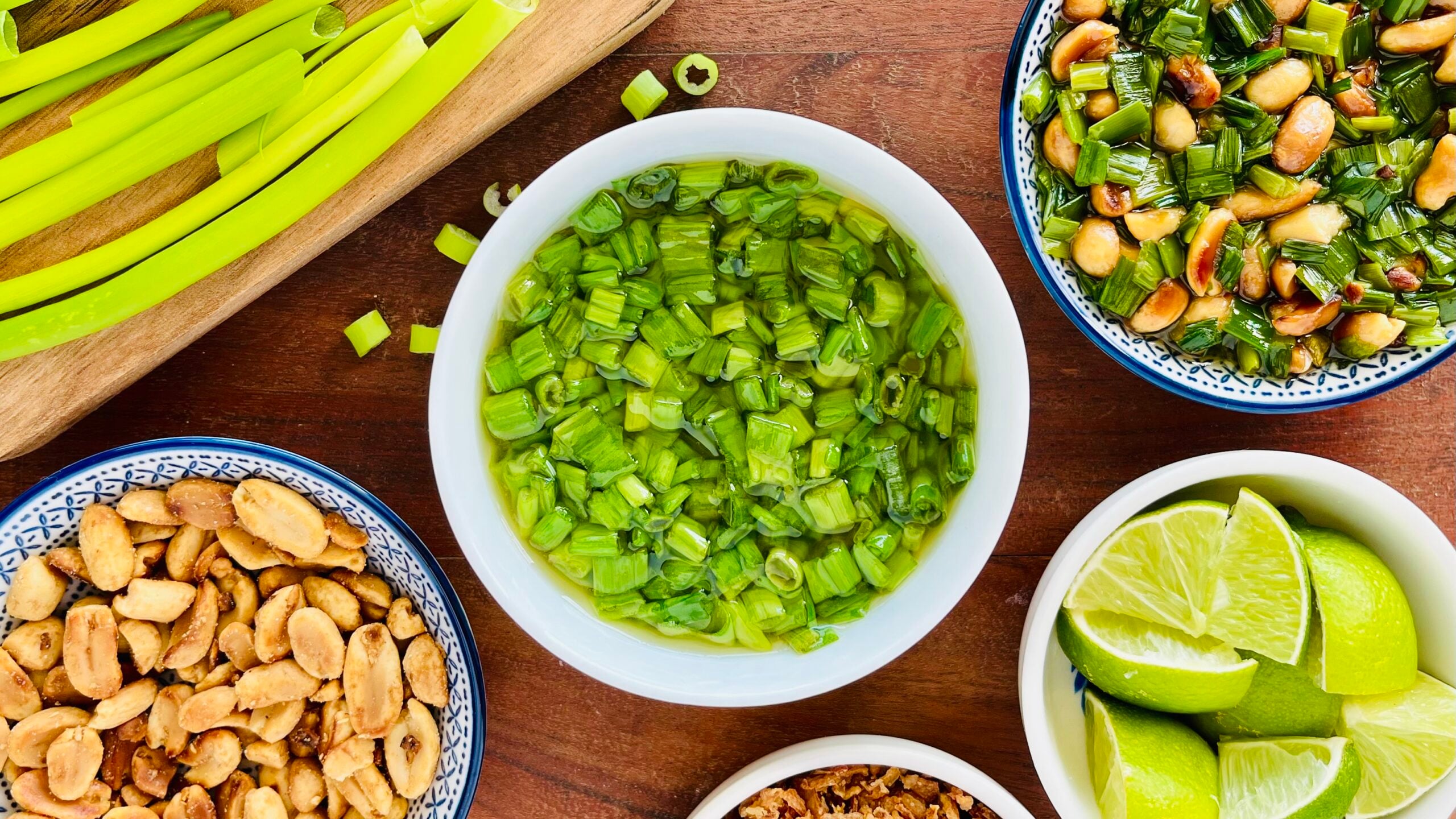
This Vietnamese scallion oil recipe for mo hanh makes a Vietnamese dressing that’s as much about the unctuous mouthfeel as the rich, sweet flavours and vibrant colour. In Vietnam, mỡ hành is the vivid green onion dressing spooned over grilled seafood, especially oysters, clams, scallops, and cockles. The richness and sweetness of the spring onion oil provides the perfect balance to plump briny molluscs that taste of the salty sea. It’s also fantastic drizzled over steak and vegetables.
If you’re a seafood lover who has spent an evening in Vietnam perched on a tiny plastic stool on a beach or in a boisterous laneway eatery, slurping oysters and razor clams drizzled with this deliciously-rich sweet Vietnamese spring onion dressing, you know what I’m talking about. If you haven’t, make that a priority. In the meantime, make this Vietnamese scallion oil recipe for mỡ hành.
You’ll love this Vietnamese spring onion oil if you’re fond of tucking into fresh seafood just-cooked on a grill or barbecue, dressed with little else but a squeeze of lemon and a sprinkle of fresh parsley or dill. Spoon the moreish dressing over charred octopus, whole fish or lobster halves and there’s no going back. Serve dishes of the oily green onion dressing on the table as a dipping sauce for prawns and crab legs and guests will be asking for the recipe.
In Hanoi, where we lived on ‘Food Street’, and first sampled mỡ hành; on Halong Bay, where we first learned to make mỡ hành; and at dreamy Dam Lap An, between Hoi An and Hue, one of my favourite places to savour this Vietnamese specialty, the scallion oil is spooned onto oysters with its close companions, crushed roasted peanuts and crunchy fried shallots. We have a recipe here for those grilled oysters with scallion oil, peanuts and shallots called hàu nướng mỡ hành.
But before I tell you more about this Vietnamese scallion oil recipe for mỡ hành, I have a favour to ask. Grantourismo is reader-supported. If you’ve enjoyed our recipes, please consider supporting Grantourismo. You could buy a handcrafted KROK, the best mortar and pestle ever; book a cooking class or meal with locals on EatWith; or buy something on Amazon, such as these best new cookbooks for 2025-26, cookbook for culinary travellers or classic cookbook for serious cooks.
Looking for more inspiration? We’ve got thousands of recipes in our archives from around the world from places we’ve lived, worked, travelled, and loved. And note that you can save your favourites in a private account by clicking on the heart on the right of posts. Now let me tell you more about this Vietnamese spring onion oil recipe for mỡ hành.
Vietnamese Scallion Oil Recipe for Mo Hanh for Seafood Dishes
I vividly recall the first time we tried this addictively-delicious Vietnamese scallion oil at a brightly-lit bia hoi joint in Hanoi that specialised in seafood, as the vivid green onion dressing was spooned over absolutely everything. We washed the lot down, clinking recycled glasses of Vietnam’s famous frothy ‘fresh beer’ in between bites.
We were with a group of Hanoi locals and long-term Vietnam expats who ran a small tour company, riding around Vietnam’s elegant ancient capital, enchantingly illuminated after dark, in ex-military jeeps and motorbikes. We were testing out an early incarnation of a bia hoi tour, which was essentially a Hanoi pub crawl with food. It was the best fun.
The next time we sampled mỡ hành was in Halong Bay, where we first learned to make mỡ hành, and then at dreamy Dam Lap An, between Hoi An and Hue, one of my favourite places to savour this Vietnamese specialty, where the scallion oil is spooned onto oysters with its close companions, crushed roasted peanuts and crunchy fried shallots. I’ll share a recipe for that dish, hàu nướng mỡ hành, very soon.
It was when we tasted the sweet and savoury Vietnamese spring onion oil on a series of Halong Bay cruise boats, testing out cruises on Halong Bay and Lan Ha Bay for magazine stories, that I seriously became enamoured with the sweet scallion oil. Almost every meal on a cruise began with a plate of grilled oysters drizzled with spring oil and sprinkled with pan-roasted peanuts and crunchy fried shallots.
And it was on those Halong Bay cruises that we learnt to make this Vietnamese scallion oil. One of the things to do on a Halong Bay cruise in the evening — after an action-packed day in the sun spent visiting floating fishing villages, clambering around caves, kayaking beneath the karsts, and cycling on Cat Ba Island — is a Vietnamese cooking class.
While this Vietnamese scallion oil is mainly spread over oysters and other seafood in Vietnam, it’s also fantastic drizzled over a great steak as you’d do with chimichurri in Argentina, or doused onto vegetables. I’ve spotted mentions online of how mỡ hành is spooned over corn cobs sold in the streets of Vietnam.
But in my experience that street corn condiment includes fish sauce and coconut milk, as it does with this Cambodian grilled corn called poat dot. Of course, that only goes to show how versatile this Vietnamese scallion oil is, which is often combined with roasted peanuts just before spooning onto oysters, followed by a sprinkle of crispy shallots, and squeeze of lime. I’ll be sharing that recipe very soon.
So… I’ve been using scallions and spring onions interchangeably here, and I’ve mentioned green onions, because in Southeast Asia they’re typically used interchangeably. But are scallions, spring onions and green onions the same thing?
Scallions vs Spring Onions vs Green Onions
A Vietnamese mỡ hành recipe mostly gets translated to a ‘Vietnamese scallion oil recipe’ online and I want home cooks to find this recipe when they’re researching the green Vietnamese seafood dressing, so I’ve done the same in this recipe post.
However, for our readers from Australia and other countries, mỡ hành is a Vietnamese spring onion oil recipe. Because Australians tend to use ‘spring onion’ more, although ‘scallion’ and ‘spring onion’ also get used interchangeably in Australia, and other parts of the world, just as the terms do in Vietnam, where ‘scallion’, ‘spring onion’ and ‘green onion’ are all often used to mean the same thing.
When we lived in Vietnam, our Vietnamese friends worked in food and/or travel. They were chefs, restaurant owners, cooking instructors, and culinary tour guides; many were multilingual, used to adapting their vocabulary depending on what countries the English speakers they were talking to came from. And many of our Vietnamese friends had also lived or been educated overseas, or were born abroad but identified as Vietnamese.
But are spring onions, scallions and green onions actually the same thing? Well, they’re what we call “same same but different” here in Southeast Asia. But one thing we can say is that they’re all part of the onion family, so let’s start with the common onion.
Onions
Closely related to garlic, chives and leeks, cultivated onions, Allium cepa, originated in the Middle East and date way back to prehistoric times. In the beautifully illustrated book The Origins of Fruit and Vegetables by Jonathon Roberts, which rarely leaves my desk, Roberts reveals that traces of onion bulbs found in Palestine (along with fig seeds and date stones) dated to the Early Bronze Age.
Onions also appear in carvings on ancient Egyptian tombs, and the cost of the onions and radishes bought to feed labourers was recorded on pyramids built before 3,000 BC, Roberts tells us. Soon after their early domestication, onion seeds and bulbs travelled the world with traders.
From the Middle East, onions were carried west to the Mediterranean and east to India, evolving in their new habitats into different colours and shapes. Roberts found that everyone from Hippocrates in Ancient Greece to Pliny the Elder in Ancient Rome wrote about onions that were round and flat, white, yellow and red, and bitter and mild.
By the Medieval period, onions were common throughout Europe, from where they travelled to Africa, Asia and the Americas. Climates and growing conditions determined the textures and flavours that onions took on, Roberts revealed. Grown all year in temperate weather, Mediterranean onions became thinner-skinned, softer and juicier, while Northern European onions would have thicker, tougher skins to survive cold winters.
But no matter how they end up, all onions start out as little bulbs with long hollow stems, marked in different degrees by their distinctively pungent taste and smell, produced by alkyl sulphides, which make our eyes water. What happens next in their stage of growth is what distinguishes spring onions, scallions and green onions — depending where you come from!
Spring Onions
Spring onions have tiny white bulbs and long green hollow leaves or stems, and are simply very young onions or Allium cepa. Their name spring onions derives from the fact that they were traditionally planted in autumn so they were ready for harvesting in spring for salads. They’re typically finely sliced and sprinkled on salads, and in Southeast Asia they’re showered on noodle soups, rice porridges, and fried rice dishes.
Scallions
Scallions are slightly more mature spring onions when they’re picked. Yep, they’re still just young onions, Allium cepa. Scallions have a slightly larger, rounder, white bulb than spring onions, with slightly larger, long green hollow leaves or stems — which explains why scallions and spring onions are often used interchangeably and often confused.
There’s not a lot of difference between them and they’re used in much the same way. But while you can finely slice the green part and sprinkle it onto dishes, there are myriad uses for the white bulbs. They can be used whole like tiny white onions, which is why they’re also called salad onions. But are also fantastic sliced and fried until crispy, like shallots.
Shallots
And what about shallots? Well, to much of the world, shallots, also called eschalots in French, are small onions that divide quickly, growing in clusters, just like garlic. They’re usually a pink-red, pink-purple or coppery-brown in colour and grow in various shapes, from small segments like garlic cloves to small round onions and a tear-drop shape to a long elongated shape.
We always have a bunch of shallots in a basket on our kitchen counter at home in Siem Reap, as shallots are used a lot in Southeast Asian cuisines, and we’ve used them in our cooking for as long as we can remember. I often use shallots instead of larger onions, as shallots are sweeter than onions, even sweet red onions, like Tropea’s onions.
But according to the lovely Aussie cookbook writer Alice Zaslavsky in her beautiful tome on all things vegetables called In Praise of Veg, some Australians call spring onions ‘green shallots’, which was news to me, and which they’re clearly not. But there you go.
Just a few tips to making this Vietnamese scallion oil recipe for mỡ hành as it’s a quick and easy condiment to prepare.
Tips to Making this Vietnamese Scallion Oil Recipe for Mỡ Hành
I only have a few tips to making this Vietnamese spring oil recipe for mỡ hành as it couldn’t be easier to make and takes just minutes.
Ingredients
Just a couple of quick tips on the key ingredients for this mỡ hành recipe.
Scallions and Spring Onions
Whatever you want to call them, and whichever you choose to use, make sure to buy super-fresh scallions or spring onions, and only use the green part. Keep the white parts, which you could slice finely to use in omelettes, pastas or salads or fry up until they’re crispy. Wash the green parts and let them dry naturally or pat them dry.
Vegetable Oil
Vietnamese scallion oil recipes for mỡ hành call for vegetable oil, but you could use any neutral cooking oil such as canola oil.
Caster Sugar
If you’re using good fresh spring onions or scallions you might not even need sugar. I rarely use sugar in my cooking these days. If you follow a sugar-free diet, you could easily leave out the caster sugar and use less fish sauce. A little extra sugar just brings out the sweetness of the onions more and balances the fish sauce.
Fish Sauce
Use a good quality Vietnamese fish sauce if you can source it, but otherwise a Thai fish sauce, which is more readily available. You just want a quality fish sauce that isn’t too salty.
Salt and Sugar
A note on the use of salt and sugar, which I’ve spotted in some Vietnamese scallion oil recipes: while some recipes call for salt (and quite a lot of salt at that), in my experience in Vietnam, fish sauce was used instead of salt. I’ve practically eliminated salt from my diet due to my blood pressure, and I adore fish sauce, so I’d rather use fish sauce that salt.
The same Vietnamese spring oil recipes that call for salt usually also call for sugar, and quite a lot of sugar. I spotted one mỡ hành recipe that called for 1 teaspoon of salt and 2 teaspoons of sugar for just 100 g of spring onions. I tested that recipe and it was way of out balance for me and was both too salty and too sweet.
But then I cook with very little sugar and salt these days. So, as usual, it’s always best to taste and adjust recipes to suit your palate, just as your grandmother might have when she used her instinct and experience rather than follow a recipe to the letter.
Step-By-Step Process
This Vietnamese scallion oil recipe for mỡ hành is a cinch to make, taking just ten minutes or so, but here’s a quick rundown of the process.
Prep the Scallions/Spring Onions
To a stainless steel mixing bowl, add the finely-sliced green parts of the scallions — or spring onions or green onions, depending on where you are and what you call them.
Heat the Vegetable Oil
In a small pan over medium-high, heat the vegetable oil just until it begins to smoke.
Pour the Oil on the Scallions/Spring Onions
Immediately pour the oil into the stainless steel bowl and stir until the sliced scallions are fully coated and start to soften.
Add Sugar and Fish Sauce
To the same bowl, add the half teaspoon each of caster sugar and fish sauce (or, if you prefer, salt, to taste) and stir until well-combined and the oily dressing takes on a smoky appearance and unctuous texture.
Adjust to Suit Your Taste
Taste and adjust the seasoning to suit your palate, then set the bowl aside to allow the scallion oil to reach room temperature.
Serving the Vietnamese Scallion Oil
If you’re using this Vietnamese scallion oil with seafood and you’re serving individual seafood dishes, you could spoon it over molluscs such as oysters, clams, razor clams, or mussels, or even fish fillets, when you plate the individual dishes in the kitchen.
If you’re serving platters of seafood that you’re planning on setting at the centre of the table for guests to help themselves, then serve the scallion oil in small bowls so guests can spoon on as much or as little as they like.
I love to serve a dish of spring onion oil with a platter of chilled cooked prawns or crab legs, as it’s also fantastic for dipping and dunking, not just spooning and spreading.
You could also provide small bowls of crunchy pan-roasted peanuts, crispy fried shallots, and wedges of lime or lemon for squeezing, all of which are wonderful companions to scallion oil. I’ll provide a recipe for oysters with scallion oil, roasted peanuts and fried shallots very soon.
Note if you like the idea of combining the scallion oil with the roasted peanuts, like you see in the image above, do that at the last minute, just before setting the condiments on the table so the peanuts don’t go soft.
Storing the Vietnamese Scallion Oil
If you’re not serving the spring onion oil straight away, transfer it to a screw-top jar and refrigerate it, but note that it won’t be as vividly coloured the next day.
Before storing, leave the scallion oil on the kitchen counter to return to room temperature, and give it a thorough stir before transferring it to a serving a dish or spooning it over seafood.
Vietnamese Scallion Oil Recipe for Mỡ Hành

Equipment

Ingredients
- 6 scallions - also called spring onions or green onions, green parts only, washed and dried, and thinly sliced
- ½ cup vegetable oil - or another neutral oil such as canola
- ½ tsp caster sugar - or super-fine white sugar, optional
- ½ tsp fish sauce - or, if you prefer, salt to your taste
Instructions
- To a stainless steel mixing bowl, add the finely-sliced green parts of the scallions — or spring onions or green onions, depending on where you are and what you call them.
- In a small pan over medium-high, heat the vegetable oil just until it begins to smoke then immediately pour the oil into the stainless steel bowl and stir until the sliced scallions are fully coated and start to soften.
- To the same bowl, add the half teaspoon each of caster sugar and fish sauce (or, if you prefer, salt, to taste) and stir until well-combined and the oily dressing takes on a smoky appearance and unctuous texture.
- Taste and adjust the seasoning to suit your palate, then set the bowl aside to allow the scallion oil to reach room temperature.
- If you’re not serving the scallion oil straight away, transfer it to a screw-top jar and refrigerate it, but note that it won’t be as vividly coloured the next day.
- Before storing, leave the scallion oil on the kitchen counter to return to room temperature, and give it a thorough stir before transferring it to a serving a dish or spooning it over seafood.
Please do let us know if you make this Vietnamese scallion oil recipe for mỡ hành as we’d love to know how it turns out for you and how you like to use this Vietnamese spring onion oil.