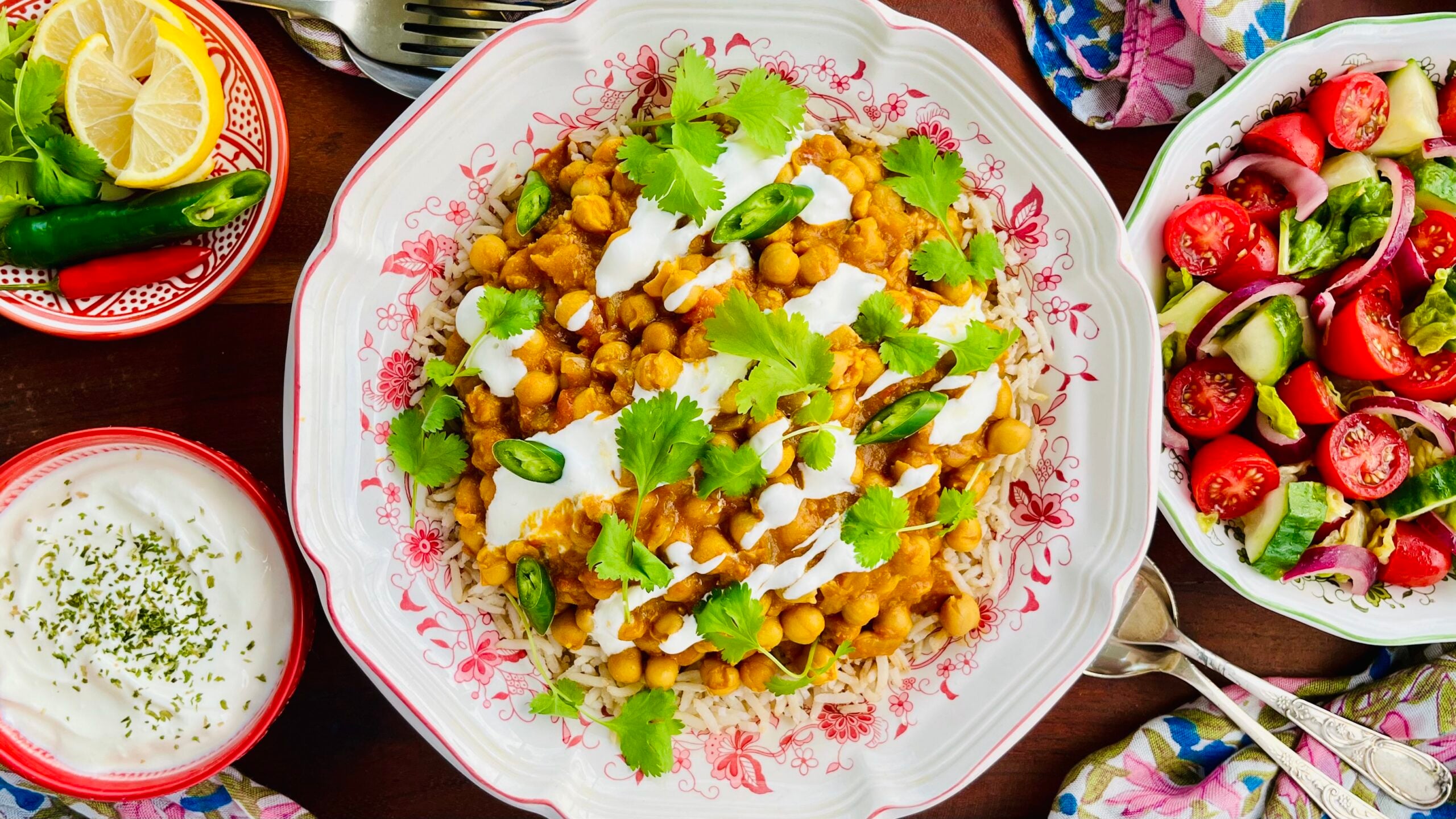
This Afghan chickpea stew recipe for qurma-e nakhod or saland-e nakhod makes a gently spiced chickpea stew from Afghanistan that also gets called an Afghan chickpea curry due to the combination of spices intrinsic to so many curries. It’s richly spiced, creamy courtesy of a garlic yoghurt sauce stirred through the stew and drizzled on top, and fragrant thanks to a shower of fresh coriander. Dial up the heat with fresh green chillies if you like, serve it on steamed basmati rice with a side salad, or scoop it up with naan.
You’ll love this Afghan chickpea stew recipe with garlicky yoghurt if you enjoy a Punjabi chickpea curry but find it a tad too spicy; they’re two of my favourite chickpea recipes but this chickpea stew is the one I cook when I crave comfort over heat. I’ve been making this more gently-spiced chickpea stew from Afghanistan more regularly since I’ve been back in Australia taking care of my elderly mum, who can’t eat spicy food.
We’ve long been lovers of chickpeas: chickpea dips, salads, pastas, sides, stews, and curries; chickpeas for breakfast, lunch or dinner. For many years this Moroccan chickpea soup Terence learnt to make in Marrakech was on rotation. And I love to linger over a bowl of hearty harira. It’s hard not to be chickpea devotees after almost a decade in the Middle East, where chickpeas star in so many Middle Eastern dishes, from creamy hummus to brothy hummus balila.
It was in the Middle East where we first tried this Afghan chickpea stew after moving to Abu Dhabi way back in 1998. It was at a simple backstreet eatery, popular with taxi drivers from Afghanistan, Pakistan and India, that had been suggested by our Indian colleague whose job was to help new staff set up home and settle in fast. Peter’s neighbourhood tips included local eating spots that became favourites.
But before I tell you more about that and this Afghan chickpea stew recipe, I have a favour to ask. Grantourismo is reader-supported. If you’ve enjoyed our recipes, please consider supporting the site. You could buy a handcrafted KROK, the best mortar and pestle ever; or book a cooking class or meal with locals on EatWith; or buy something on Amazon, such as one of these best new cookbooks or cookbooks for serious cooks.
Looking for more inspiration? We’ve got thousands of recipes in our archives from around the world, from places we’ve lived, worked, travelled, and loved. And note: you can save your favourites in a private account by clicking on the heart on the right of any post. Now let me tell you more about this Afghan chickpea stew recipe for qurma-e nakhod or saland-e nakhod.
Afghan Chickpea Stew Recipe with Garlic Yoghurt Sauce
I love the current iteration of this Afghan chickpea stew recipe for qurma-e nakhod or saland-e nakhod that I’m sharing here. The recipe has gone through countless revisions in recent years – from dramatic adjustments as I came across new-to-me recipes in old cookbooks to small tweaks to test slightly different spice combinations. It’s not as oily or as salty as the chickpea stew in that Abu Dhabi eatery, and tastes more like home-cooked comfort food.
Although it has to be said, despite becoming a restaurant staple in the Afghan diaspora, this chickpea stew started life as a home-cooked favourite, which those unpretentious neighbourhood eateries in Abu Dhabi served up to their homesick customers. It was an affordable filling meal that satisfied hunger pains as much as pangs of nostalgia, and a longing for home, and the cooking of wives and mothers, and meals with loved-ones.
There was no public transport when we lived in Abu Dhabi, and during our five years in the UAE capital, Terence and I caught cabs to and from work every day, as well as to do the shopping and go out to dinner. I can’t tell you how many times we hopped into a taxi to find a teary-eyed driver from the mountains of Afghanistan or Pakistan listening to a cassette tape his wife had lovingly made and posted him. It broke my heart every time.
We didn’t speak Dari, Pashto or Balochi, or Punjabi, Sindhi or Urdu. It was challenging enough learning a little Arabic. But I knew that the women on the tapes were sharing news from home, and from the levels and tones of their voices, whether we could hear kids playing loudly in the background, or family members shouting out greetings, I could tell how intimate or everyday the conversation on the cassettes were: whether she was telling her husband how much she missed him, or whether little Abdul and Mohammed needed new shoes.
The second we showed an interest – pointing to the cassette player and asking if that was his wife and kids (of course it was, it was a conversation starter) – the driver’s eyes would light up, he’d hit pause, pull down the visor, and pull out well-thumbed photos of his loved ones, which he’d pass to us in the back. There’d be a portrait of a beloved wife, maybe a wedding photo, pics of smiling kids, perhaps a formal photo of extended family, staged by a professional photographer.
Drivers who spoke a little English shared stories from home. Drivers who didn’t would give Terence a thumbs up when he correctly guessed the kids’ ages, and place a hand on their hearts when I complimented their wives with an enthusiastic “Helwa!!!”. It means ‘beautiful’ in Arabic.
Over time, we learnt that it was normal for taxi drivers to spend many years away from their families, working abroad in the Arabian Peninsula emirates. While most drivers came from rural villages, had little education, and few options for the future if they’d stayed home, others had been professionals, from teachers to engineers; they said they could earn more money driving a cab in Abu Dhabi than repairing computers in Kabul or building bridges in Balochistan.
Some hadn’t seen family in decades: middle aged parents were now elderly, grandparents had passed away, newborn babies were in their teens. They didn’t want to waste hard-earned savings on flights home that could be spent on their kids’ education, building a new house, or starting a small business when they eventually saved enough to finally return.
Understanding that context, the food from Afghanistan, Pakistan and India that was cooked up in those simple eateries in the dusty backstreets of downtown Abu Dhabi, was so much more than sustenance, it was a connection to homes and loved-ones they’d long ago left and longed to return to. As new expats, we didn’t understand that at first; we wanted to try everything that was new to us. But it wouldn’t take long.
Chickpea stews appeared on those menus as qurma-e nakhod – ‘qurma’ means stew or sauce and ‘nakhod’ chickpeas – and they were either very oily like a proper curry, or, at vegetarian eateries, more made with more water and were brothy like a soup. We didn’t make that chickpea stew or other favourites at home when we lived in Abu Dhabi and later Dubai. If we didn’t eat out, we’d order takeaway or home delivery, which was quick, cheap, and meant we could open a bottle of wine.
It wasn’t until years after leaving the Middle East and settling in Southeast Asia that we began craving the food we missed from the region: Arabic mezze, Moroccan tajines and Indian curries. And it wasn’t until one day when I cooking Christine Manfield’s Punjabi chole in our Siem Reap kitchen that I remembered qurma-e nakhod and craved that gently-spiced chickpea stew.
When I unexpectedly found myself back in Australia taking care of my elderly Mum, in a small regional city in the countryside with a big multicultural population that included Afghan refugees; where almost every taxi driver we’ve had has been from India or Pakistan; and where there are eight Asian grocery stores within a short stroll – and mainstream supermarkets with impressive international food aisles – I began to regularly cook this comforting Afghan chickpea stew.
My first source for an Afghan chickpea stew recipe was the 1979 edition of the Complete Middle East Cookbook by Tess Mallos, a heavy tome of a cookbook I’d grown up with as a child of parents who were always cooking different cuisines from around the world – a fashionable thing to do in Sydney in the Seventies, but mum and dad also had a beachside French restaurant when I was a kid, and later, when I was a teen, a holiday town takeaway shop.
The legendary Tess Mallos was Australia’s expert on Mediterranean and Middle Eastern cookery. Of Greek heritage, she travelled extensively throughout the region and here cookbooks were groundbreaking, covering the cuisines of everywhere from Armenia to Yemen. Her recipe for qurma/korma, translated as a ‘meat sauce’, includes stewing lamb or beef and ‘dal nakhud’, and half a cup of oil, and it takes me right back to those Abu Dhabi eateries.
I began tweaking that Afghan chickpea stew recipe after finding a pre-loved paperback cookbook called Afghan Cuisine by Afghan-American Nafisa Sekandari published in 2003 (updated in 2010) in an Australia charity shop. This is the book to seek out if you really want to understand qurma, which the author spells as ‘quarma’ and translates to ‘sauce’, as there are two chapters dedicated to both meat-based and vegetarian quarmas, with almost 40 quarma recipes.
But it’s two more recently published cookbooks that have influenced this Afghan chickpea stew recipe the most: the enchanting Parwana, Recipes and Stories from an Afghan Kitchen by Durkhanai Ayubi and her mother Farida Ayubi (a book I’ve been wishing for since Terence and I ate at their wonderful Parwana restaurant in Adelaide many years ago), and Michael Shaikh’s The Last Sweet Bite.
The Parwana recipe is simply titled ‘Nakhot’ (chickpeas) but in the intro is described as a “simple rustic chickpea curry that is enjoyed throughout Afghanistan…” and with one cup of sunflower oil, of all the chickpea stew recipes I’ve tested over the years, it’s most like that Afghan chickpea stew in Abu Dhbai, but is more richly spiced. I’ll tell you why below.
It’s Michael Shaikh, who lived and worked in Afghanistan for many years, and shares his Afghan friend’s chickpea stew recipe in The Last Sweet Bite, who calls what I’ve long known as a qurma/kurma and specifically qurma-e nakhod, ‘saland-e nakhod’. His Afghan chickpea stew recipe is also the only one I’ve come across that calls for the garlic yoghurt sauce to be stirred into the stew, as well as serving it on the side. Great idea!
I’ll tell you more about both the exquisite Parwana and Michael Shaikh’s The Last Sweet Bite, which resonates with me on so many levels, in another post – or two! For now, I have some tips to making this Afghan chickpea stew recipe for qurma-e nakhod – or saland-e nakhod.
Tips to Making this Afghan Chickpea Stew Recipe
Here are some quick tips to making this Afghan chickpea stew recipe for qurma-e nakhod or saland-e nakhod, but first a few notes on the key ingredients.
Ingredients
The key ingredient of this Afghan chickpea stew recipe for qurma-e nakhod or saland-e nakhod are chickpeas, also called garbanzo beans, so let’s start there.
Chickpeas — Dried or Canned?
Our Afghan chickpea stew recipe calls for two cans of chickpeas, which I recommend draining and rinsing. Two cans makes my idea of four portions, as you’ll be serving the stew with steamed basmati rice and naan (or other flatbread) and perhaps a salad on the side. But if you’re a big eater, don’t eat rice, and really want to savour this chickpea stew on its own, then it might only be enough for two.
From the Ayubi ladies’ chickpea recipes in the Parwana cookbook to Michael Shaikh’s saland-e nakhod recipe in The Last Sweet Bite, most Afghan chickpea stew recipes call for cooks to start with dried chickpeas, soaked overnight. However, my guilt was assuaged after I found Afghan Cuisine in which Afghan-born Nafisa Sekandari assures readers that using canned chickpeas is perfectly fine.
If you want to begin with dried chickpeas, you’ll have to start the night before or in the morning, as dried chickpeas usually need to be soaked for at least 8 hours. Michael Shaikh’s recipe calls for two cups of dried chickpeas to be picked over for grit and broken or shrivelled skin, rinsed in a fine mesh sieve under running water, transferred to a bowl, covered generously with water, and soaked overnight.
As the Ayubi women, who recommend covering 2 cups of dried chickpeas in at least 5cm of cold water, point out: the chickpeas expand, so you need a big bowl large enough to accommodate them.
While I’ve eliminated a lot of high sodium processed food since my dangerously-high blood pressure diagnosis last year, and wherever possible I start cooking everything from scratch, including soaking dried legumes, I’ve been using canned chickpeas for a few reasons.
Firstly, the dried chickpeas I’ve used a few times since I’ve been back in Australia taste really terrible (I suspect they’ve been very old); secondly, the sodium content of the canned chickpeas I use isn’t that high; and lastly, most people I know here in Australia are working 2-3 jobs and/or have families to feed and say they just can’t get organised enough or can’t be bothered soaking chickpeas overnight. And since I’ve been taking care of my mum, which is like taking care of a few kids, I get it. I didn’t before, but I do now.
Cooking Oil or Ghee?
This Afghan chickpea stew recipe calls for vegetable oil. All of the chickpea stew recipes I’ve used over the years list vegetable oil or sunflower oil, and I’ve tended toward vegetable oil. My Russian-Ukrainian grandmother used sunflower oil a lot in her cooking, but I reckon the sunflower oil tasted better back in the day; that’s something I need to research.
But after receiving an email from a reader overnight asking why I wasn’t using ghee. I do have ghee on hand, but I’ve never come across a chickpea stew recipe calling for ghee, so I decided to consult two neighbours who have become friends, rather than the cookbooks: a North Indian pharmacist and Central Afghanistan-born student (a Hazara refugee studying English at the college across the road, who I met at the nearby Chinese temple; we bonded over a love of food and the serenity of the gardens).
Both passionate cooks, addicted to Masterchef Australia, who learnt to cook by helping their mothers, aunties and grandmas, they told me that in Afghanistan and Northern India, oil is mostly used for cooking savoury dishes, the exception being meat-based dishes and sweets, when ghee is used, and that oil, especially vegetable oil or sunflower oil, is used for cooking vegetable dishes. So I’m sticking with oil.
Green Chillies
I’ve listed the fresh green chillies as optional, as some Afghan chickpea stew recipes call for green chilli (Michael Shaikh’s saland-e nakhod recipe, and most of Nafisa Sekandari’s quarmas; jalapenos are listed), and some don’t. I use chilli depending on my mood and usually use a long mild green chilli; one finely diced in the stew, and one sliced for garnishing.
Spices
You could safely make this Afghan chickpea stew recipe for guests who like spicy food but not necessarily fiery food; friends or family who prefer Vietnamese or Cambodian food to Thai food. But what I love about this chickpea stew is that it’s so versatile. You could bump up the spice levels if you like, or tone things down by stirring through more of that tangy garlic yoghurt.
Ground coriander, cumin and turmeric are essential to an Afghan chickpea stew, with the flavours of coriander and cumin dominating, and turmeric adding earthy flavours and colour. Ground cardamom, cloves and cinnamon can feature, with cinnamon sticks or quills called for, which I use liberally at home in Cambodia but less so here in Australia, where they’re more expensive.
Black pepper sometimes makes an appearance (also best freshly ground), and Michael Shaikh’s recipe calls for a lot, but I suggest using it to taste.
Some Afghan chickpea stew recipes call for chaar masalah, a quintessentially Afghan spice mix made from fresh whole spices that are ground and toasted, or curry powder. The Parwana cookbook’s nakhot recipe calls for both spice blends and the result is a richly-spiced Afghan chickpea curry rather than a chickpea stew, which is what they call the dish in the intro, after all.
Garlic Yoghurt Sauce
Having lived in the Middle East for so long, I have a tendency to put a yoghurt or tahini sauce on anything and everything even remotely Middle Eastern, but it was Terence, who worked in a restaurant kitchen (in contrast to cafes like me) and who spent years cooking from restaurant cookbooks, who taught me to drizzle instead of dollop.
A garlicky yoghurt sauce features as a side or condiment in all the Middle Eastern and Afghan cookbooks I’ve used over the years. Tess Mallos calls for ‘chakah’ or drained yoghurt, combined with 2-3 garlic cloves and salt to taste for several recipes, while Nafisa Sekandari’s always call for a sprinkle of dried mint.
While the kind of yoghurt isn’t specified, drained yoghurt is dense and creamy, so my Afghan chickpea stew recipe calls for creamy Greek yoghurt, but you could certainly use another natural, plain, whole fat yoghurt. I use like 2 garlic cloves, minced, but use more or less depending on your love for garlic.
Herbs
All Afghan chickpea stew recipes I’ve cooked over the years call for fresh coriander (cilantro to our American readers), but the Ayubi women’s nakhot recipe in the Parwana restaurant cookbook calls for fresh parsley. I prefer fresh coriander leaves, but both work, so know parsley is an option if you’re one of those people for whom coriander/cilantro tastes like soap.
Step-By-Step Process
This Afghan chickpea stew recipe for qurma-e nakhod or saland-e nakhod is fairly straightforward to make, but here’s an overview of the steps for those of you who like them, otherwise head directly to the recipe.
Prep the Chickpeas
If you’re going to start with dried chickpeas (see above), then you’ll need to begin the night before and start with this step, otherwise, if using tinned chickpeas, start our Afghan chickpea stew recipe with the garlic yoghurt sauce.
Make the Garlic Yoghurt Sauce
Transfer the Greek yoghurt to a small bowl, mince the garlic into the bowl, stir to combine well, and taste. Adjust the garlicky yoghurt as you like, adding another clove of garlic and perhaps some salt, then cover and refrigerate.
Cook the Onion
To a large pan over medium-high heat, add the vegetable oil, heat until shimmering, add the diced onion, and fry, stirring occasionally, until the onion is translucent, then reduce to medium heat.
Add Fresh Green Chilli (Optional)
Add the fresh green chilli if you’re using it, and if you’re not, skip to the next step. Stir to combine the green chilli with the onion and continue to cook until the onion begins to brown. If needed, if the pan is getting a little dry, just add a bit more oil.
Add the Spices
While the onion is cooking, add the spices to a small bowl and stir to combine. When the onion begins to brown, reduce the heat to low, add the spice mix, and stir to combine until fragrant.
Add the Tomato and Chickpeas
Stir in the diced fresh tomato and chickpeas, add 2 cups water, increase the heat to medium-high, bring to a boil, then reduce the heat to low.
Simmer and Reduce the Stew
Pop the lid on the pan partially and simmer, stirring occasionally for 20 minutes or so until the chickpeas are soft and the sauce has reduced and thickened into a stew. If the chickpeas aren’t soft enough for you, simply cook the stew for longer. If the stew is too thick, add a little more water, stir, and continue to simmer.
Finish the Stew
When you’re ready to serve, remove from the heat, stir in a tablespoon (or two) of garlicky yoghurt, taste, and adjust to suit your palate, adding salt if needed. And, it should go without saying, adding another tablespoon of the garlic yoghurt sauce if you like.
Plate and Garnish
When you’re ready to serve, distribute the chickpea stew between plates or bowls if serving it individually, or, if you’re placing it at the centre of the table as part of a shared family meal, scoop some steamed basmati rice into a big bowl, ladle the stew on top, drizzle iwith garlicky yoghurt, and shower with fresh coriander and chilli slices.
Serve the Chickpea Stew
Transfer the rest of the garlicky yoghurt to a bowl, sprinkle some dried mint on top, and serve with a classic Afghan salad and warmed naan or other flatbreads for scooping up the stew. I’m going to share recipes for an Afghan salad and Afghan naan bread soon.
Afghan Chickpea Stew Recipe with Garlic Yoghurt Sauce

Equipment
Ingredients
- 1 cup Greek yoghurt - or other natural, plain, whole fat yoghurt
- 2 garlic cloves - minced, or more or less if you like
- 2 tbsp vegetable oil - or sunflower oil
- 1 large brown onion - finely diced, or red onion for sweetness
- 2 fresh green chillies - optional: divided, mild, medium or hot as you like, one finely diced, one sliced for garnishing
- 1 tbsp ground coriander
- 1 tbsp ground cumin
- 1 tsp ground turmeric
- ½ tsp ground cardamom
- ½ tsp ground cloves
- ½ tsp cinnamon - or a cinnamon stick
- 1 large tomato - finely diced
- ½ tsp black pepper - freshly ground, or to taste
- 2 cans chickpeas - drained, rinsed
- 2 cups water - and more if needed
- salt and pepper - to taste; optional
- 1 cup fresh coriander leaves
- ½ tsp dried mint
Instructions
- Make the garlicky yoghurt sauce: transfer the Greek yoghurt to a small bowl, mince the garlic into the bowl, stir to combine well, taste, and adjust as you like, adding another clove of garlic and perhaps some salt. Cover and refrigerate.
- Cook the onion: to a large pan over medium-high heat, add the vegetable oil, heat until shimmering, add the diced onion, and fry, stirring occasionally, until the onion is translucent, then reduce to medium heat.
- Add green chilli (if using): stir to combine with the onion and continue to cook until the onion begins to brown. If needed, add a little more oil.
- Add the spices: while the onion is cooking, add the spices to a small bowl and stir to combine. When the onion begins to brown, reduce the heat to low, add the spice mix, and stir to combine until fragrant.
- Add the tomato and chickpeas: stir in the diced tomato and chickpeas, add 2 cups water, increase the heat to medium-high, bring to a boil, then reduce the heat to low.
- Simmer and reduce: pop the lid on the pan partially and simmer, stirring occasionally for 20 minutes or so until the chickpeas are soft and sauce has reduced and thickened into a stew; if too thick, add a little more water, stir, and continue to simmer.
- Finish the stew: when ready to serve, remove from the heat, stir in 2 tablespoons of garlicky yoghurt, taste, and adjust to suit your palate, adding salt if needed.
- Plate and garnish: when ready to serve, distribute between plates, or, if serving at the centre of the table, scoop some steamed basmati rice into a big bowl, ladle the stew on top, drizzle with garlicky yoghurt, and shower with fresh coriander and chilli slices.
- Serve: transfer the rest of the garlicky yoghurt to a bowl, sprinkle some dried mint on top, and serve with a classic Afghan salad and warmed naan or other flatbreads for scooping up the stew.
Please do let us know if you make this Afghan chickpea stew recipe for qurma-e nakhod or saland-e nakhod as we’d love to know how the dish turns out for you.