

Doing a tour of Cape Town’s townships to learn about the history of segregation and apartheid in South Africa in an immersive, sensitive and respectful way was high on our list of things to do in Cape Town. During our Cape Malay cooking class, Faldela had taught us the meaning of Ubuntu – being open and available, sharing, and interconnectedness – and we would see it in action during a day spent touring Cape Town’s townships with ethical tour guide Faizal Gangat.
During our Cape Malay cooking class in the vibrant Bo-Kaap neighbourhood, in the home of hospitable Faldela, whose front door was always open, she taught us the meaning of Ubuntu – sharing, interconnectedness, being open, and being available. And we would see ubuntu in action during a day spent touring Cape Town‘s townships.
There was no question about it. To really get beneath the skin of the place, and learn more about Cape Town’s history and culture, to try to understand the present, and the ongoing segregation that had shocked us, we had to visit Cape Town’s townships. But how to do it in a way that was immersive, yet respectful and sensitive? The advice from locals on touring Cape Town’s townships was unanimous: the best and safest way was on a township tour with an ethical tour operator.
Cape Capers had been recommended to us by Cape Town Tourism, our followers on Twitter, and the manager of another responsible tour company, who said of its owner, award-winning tour guide, Faizal Gangat: “That guy is a legend!” Cape Capers has a Township Experience, a District Six and Bo Kaap tour, and a Cape Care Route, showcasing inspirational township projects. Faizal offered to give us a taste of all three tours in a full-day tour. It was a transformative experience.
Touring Cape Town’s Townships and Learning the Meaning of Ubuntu
The first stops on our tour with Faizal Gangat of Cape Capers are the Cape Town neighbourhoods of Bo-Kaap and District Six. On our drive through the streets of colourful Bo-Kaap, where we’d already spent time with guide Sabelo Maku on our Cape Malay culinary experience, Faizal Gangat tells us how his ancestors came to South Africa’s Cape Town from India in 1906.
Bo-Kaap and District Six – Where a Vibrant Life was Stolen
“My wife was ‘Cape Malay’, as the Muslim slaves brought to South Africa from the Indonesian archipelago were called. She could have owned property here in Bo-Kaap,” Faizal tells us. “But as an Indian, I couldn’t.”
We cruise through the desolate area known as District Six, where large lots of long dry grass remain vacant except for a mosque and churches left untouched when the apartheid government flattened the area.
“District Six’s history begins in the 1840s as a boomtown after diamonds were discovered. It was vibrant, full of life and diversity,” Faizal says. “My wife was born here. Her father had a curry and rice house. And I married his youngest daughter and lived here as well.”
“Then apartheid came, and it was all stolen,” Faizal reveals. “In 1966, it was made a white area. If we didn’t move, they packed us up and moved us.”

“By 1970, the place was flattened. 30% of Cape Town’s population was affected. The first thing they did was build a freeway through the area.”
Faizal drives to an empty car park and pulls over.
“That was where Hanover Street ran,” he says, gesturing to a barely discernible track overgrown with weeds. “It was once the area’s lively main street.”
Faizal points to a church. “Moussa, a Muslim, was the bell-ringer of St Andrews Church,” he tells us. “Uncle Izzy and Sarah, our neighbours, were Jewish; he was in our kitchen more than his.”
On our drive to the District Six Museum, Faizal shows us an enormous mural of Nelson Mandela and anti-apartheid activists Steve Biko, Cissie Gool and Imam Haron, and points out the police station that was the scene of brutal tortures and killings of political activists.
District Six Museum
Outside the District Six Museum, once the Methodist Mission Church, the ‘plaque of shame’ mounted on the wall serves as a reminder of the thousands of people forcibly removed from their homes and other injustices that took place that whites had ignored.
Inside the impressive Museum, where multiple forms of media, art, crafts, historical materials, documents, and photographs communicate the stories and experiences of the District Six community, Faizal points out a few special exhibits.
Above us, hang large portraits of well-known former residents, including Dr Abduraman, founder of the African People’s Organisation, his daughter Cissy Gool, a Cape Town City Council member, writer Alex La Guma, and internationally-acclaimed ballet dancer, Johaar Mosaval, whose ballet school was shut down during apartheid when it was found to be multiracial.

There is a ‘memory cloth’ upon which former District Six residents have written messages and personal memories, while beneath our feet is a floor map where former residents inscribed their family names to indicate where they had lived and marked out long gone local landmarks.
Dominating the room is a collection of 75 original street signs, rescued when the community was demolished, a tangible reminder of the homes and lives destroyed by the authorities.
“The signs are very poignant for me,” Faizal reveals. “Each street sign erected here tells stories. But for me they also say that we’re rising again. Buildings and lives are being built again.”
A Lesson on the History of Apartheid
Next on our Cape Town’s townships tour is the township of Langa. On the drive there, Faizal gives us a condensed version of how South Africa got to apartheid. Its beginnings are early, way back in 1652, with the birth of colonialism and the Dutch Cape Colony in South Africa, when the Dutch planted the flag of the King of Orange on African soil. An indigenous people’s resistance formed and massacres quickly followed.
After the local population was decimated, the Dutch East India Company imported slaves from Asia, from Indonesia, Sri Lanka and India, and elsewhere in Africa, and continued doing so throughout its domination until 1790 when it went bankrupt and the British took over.
Although the British abolished slavery in 1834, slavery continued following the establishment of the Boer Republics, through the raids of Boer farms to pre-empt trouble, the Boer War, the discovery of gold and diamonds, second Boer War, and, eventually, an uneasy peace between the Boers and British.
“It’s a classic story of the brutalised who become the bullies. For them to never be bullied again, they instituted apartheid, which lasted 48 years,” Faizal explains. “When apartheid began, racial segregation was legalised and forced removals started.”
In the 1970s, protests by workers and students began, including the Soweto Uprising in 1976, and continued through the 1980s.
“There were protests, people didn’t pay their taxes, and the country became ungovernable,” Faizal says. “Billions were sent out of the country because the government could see the writing on the wall.”
A turning point came when anti-apartheid bills were passed from 1985 onwards. In 1990, then-president FW De Klerk lifted the ban on anti-apartheid groups such as the African National Congress (ANC) and on 11 February Nelson Mandela was released from prison.
In the 1990s, apartheid was legally abolished, culminating in the 1994 election when all adult South Africans were given the right to vote, no matter what their colour, and the Truth and Reconciliation Commission was established.
“That was another turning point,” Faizal tells us. “When we all said ‘I know what you did to me, and it was ugly, but I’ll forgive you.’”
Langa Township
We arrive at the fairly bleak township of Langa, one of the oldest townships, a short 15-minute drive from the centre of Cape Town. Townships such as Langa didn’t fall under city council jurisdiction, but under the government’s Native Affairs department.
“As a result, there was no money allocated here,” Faizal explains. “The townships were filthy, there was garbage everywhere. From 1994, they started to rebuild. Now Langa and the other townships are starting to feel like communities. They have sporting facilities, schools, community centres. For the first time, people can get loans and buy their own homes.”
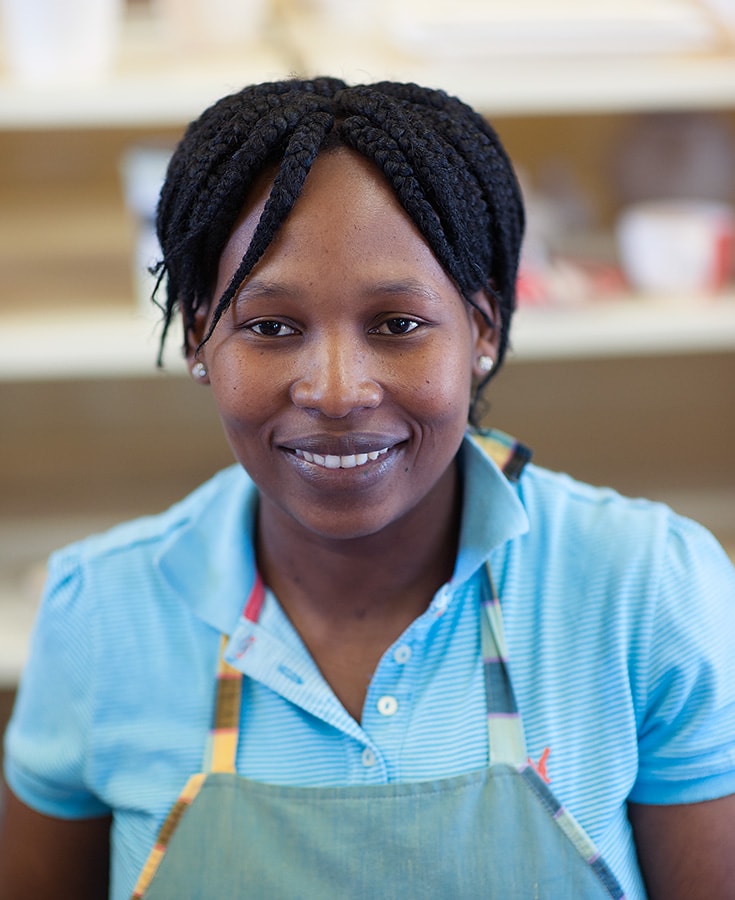
We visit the Guga S’thebe Culture, Arts and Empowerment Centre, where Faizal introduces us to artisans who are creating beautiful pottery, woodwork, and picture frames, initiatives made possible by fundraising for the centre and successful locals who have donated equipment, such as kilns in the pottery workshop and a photographic dark room.
Naleti, one of the pottery designers, talks to us about his craft and the processes they go through to make the pieces they sell at the centre. Nombulelo, who is painting the pottery, said she wanted to study psychology but couldn’t afford the education fees so she undertook a skills development program to learn skills that would “put food on the table”.
We meet Monwabisi Sobitshi, an actor and artist who makes crafts from recycled cans when he’s not running school drama workshops. Faizal asks him to perform a scene from the Fatima Dike play Isandulela, which he says is about a young man who helps a frail old gentleman get to the voting station on election day 1994.
Monwabisi plays the old man, who is so emotionally moved at being able to vote for the first time that he breaks down as he makes his way to the booth.
“If I put my hands on this paper, I will be like a new person with a present and a future,” Monwabisi says with tears in his eyes. “What do I know about freedom? I don’t know how to be free.”
It’s a powerful performance that moves me to tears.
A Walking Tour of Langa Township
Mpumie, a local guide from Langa, takes us on a walking tour of Langa Township, pointing out beautiful mosaic ‘memory towers’, schools, churches, a crèche, and a library, admittedly many of them behind high fences topped with barbed wire.
Langa was a centre of resistance against apartheid, and Mpumie points out significant spots, such as the place where seven student activists died in 1960 after Pan Africanist Congress leader Philip Kgosana led a march of 30,000 to protest the Sharpeville Massacre. Police opened fire on the Langa crowd.
Mpumie takes us to see the infamous old hostel buildings and ‘single quarters’, blamed for destroying families and creating dysfunctional communities. Constructed in the 1960s for male migrant workers, the reality was that ‘single’ rooms would typically sleep three men, with up to 64 people in one apartment, with a shared bathroom and kitchen.
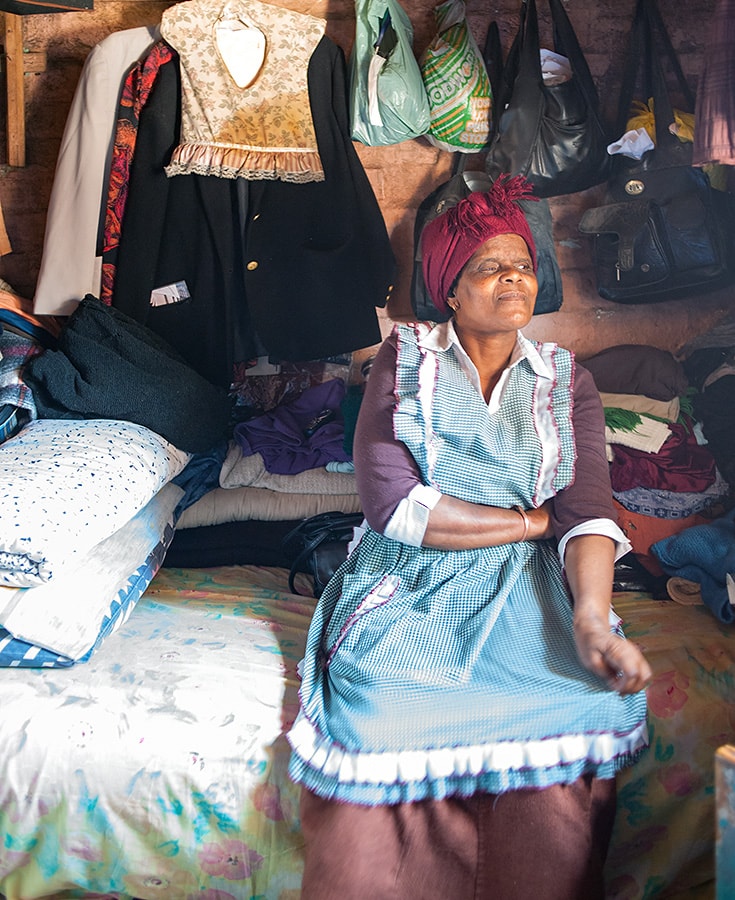
Crumbling and badly in need of renovation, the buildings still house migrant worker families. Mpumie takes us to a small dimly lit room, crammed with suitcases, boxes and bags storing personal possessions, with just three single beds. We meet one of the women from the three families that share the tiny room. From the Eastern Cape, she is wearing an apron as if she’s about to go to work, yet she tells us she is unemployed.
Mpumpie takes us to a renovated new flat. Considerably smarter, it’s still small for a family. Rent for one of these is R350 per month, yet the family only brings home a salary of R800 per month, and the husband is currently out of work.
We pass a makeshift stall in a cloud of smoke, where ‘smileys’, char-grilled sheep heads, are being prepared. Half a head costs R30, a whole head is R60. They’re a popular meal for township residents. We also visit a bar in a shack called a shabeen, where a bottle of beer is sold for R10 and a 6-pack is R38. It’s difficult to understand how anyone can even afford to eat out.
We stroll down a tidy street of compact brick and wooden houses that would be considered modest for many neighbourhoods, but according to Mpumpie this is “the Beverley Hills of Langa”. By contrast, at the end of the street is a ritzy development of contemporary two-storey townhouses that would be swish in any part of the world.
“These have been empty since they were finished over a year ago because of a complicated allocation system, plus nobody can afford the R2000 monthly rent,” Mpumpie explains.
Within sight of the swish new homes, down a dusty track, is the Joe Slovo ‘Informal Settlement’ of tiny timber and corrugated iron shacks that butt up against each other. Mpumpie tells us these homes have no fresh water. They use buckets to bring water in to bathe and wash dishes and clothes. Opposite is a row of public toilets.
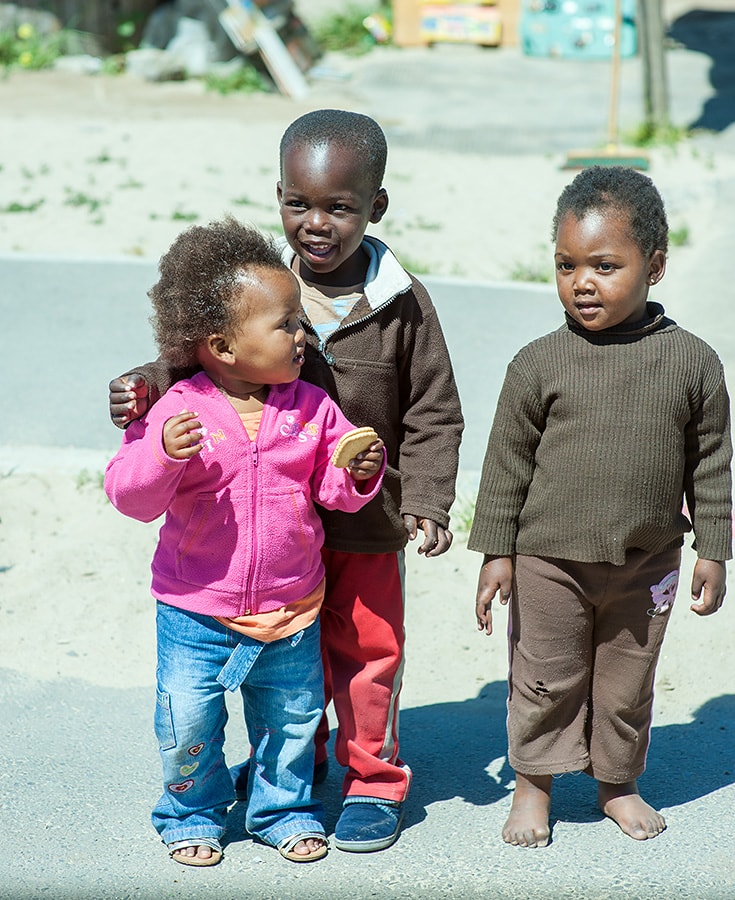
Made mostly of wood, the shacks occasionally catch fire, which can be catastrophic for the whole community, Mpumpie tells us. And when it rains, they flood. Mpumpie takes us inside one of the homes where three young boys watch television. They’re alone as their mother is working. The family has lived here for 15 years.
Victoria Mxenge Housing Project and Khayalitsha
Faizal drives us through the Victoria Mxenge Housing Project, named after the female political activist Victoria Mxenge, who was murdered by the state. The development of 140 houses was built by a group of 30 women from the South African Homeless People’s Federation who had been living in squatter shacks in the township of Khayalitsha.
Faizal tells us that the project – which doesn’t allow strangers to come and live here and boasts ‘safe houses’ – has been “a catalyst for racial harmony, with the black women here teaching women of colour how to start similar developments,” he explains.
We drive to Khayalitsha, a ramshackle township that sprawls across a flat plain. While Faizal tells us that Khayalitsha is the most developed of the townships, the particular area we’re driving through appears to be the least developed of the three townships we’ve visited so far.
Corrugated iron shacks that look as if they’d tumble down at the slightest touch appear stacked upon each other. Hairdressers, mobile phone stores, and fish shops operate out of disused shipping containers.
There is garbage everywhere, scattered across the street, and piled up in heaps by the side of the ride, the result of a recent worker’s strike, according to Faizal. It’s world’s away from Camp’s Bay.
Our final stop on our tour of Cape Town’s townships is a business in the township called Golden Flowers, developed by an Eastern Cape man named Nongauza.
A former gardener who dreamt of a rubbish heap of flowers, Nongauza was inspired by a Coca Cola can to craft beautiful flowers made from aluminium, which he paints in pretty colours and sells to interior design stores.
Nongauza’s success has enabled him to send his three daughters to university and help his Eastern Cape village. He recently donated money to build a bridge. I buy two lilac flowers and wish I could buy more.
On our drive back to the city centre, we ask Faizal why he wanted to be a guide, and why he and his doctor wife do the volunteer work that they do.
“Ubuntu,” Faizal says simply. It’s a word we have already learnt.
“Humanity. If there wasn’t a ‘you’, there wouldn’t be a ‘me’,” Faizal explains. “For our existence to be meaningful, it’s just something we have to do.”
Update: Sadly, Faizal passed away after a short illness, but his wife Robea and nephew still run the ethical and responsible tour company, Cape Capers.
Cape Capers Tours
20 Erica Street, Woodstock
021-447-0350
tourcapers.co.za



Tears. Tears of happiness and sorrow at the same time. Touching Golden Flowers, I’d heard of Nongauza.
How I miss Cape Town…
So agree with you! We had such mixed feelings about the place – simultaneous sadness and joy!
His flowers are so pretty – I bought a couple and will treasure them forever.