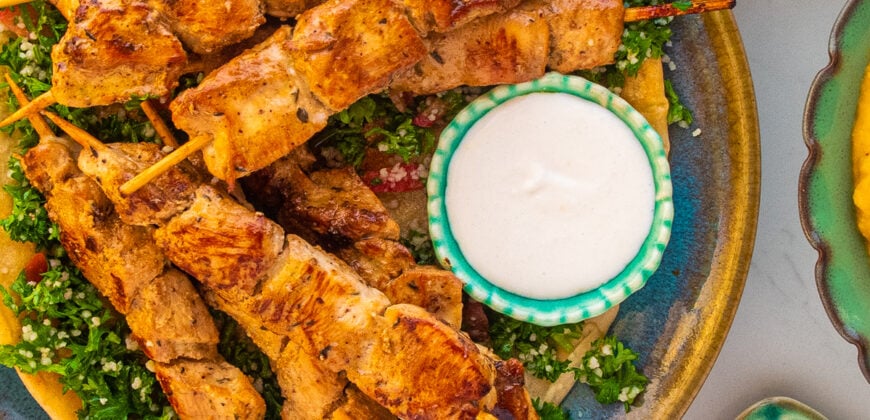
This toum recipe makes toumeya, the garlic sauce from the Middle East that’s slathered onto chicken shawarma and eaten with shish tawook, just like your favourite Arabic restaurant makes it. Traditionally made with a mortar and pestle, chefs make toum in a food processor or blender these days. You can too, especially if you don’t live in the Middle East and don’t have a Lebanese restaurant on every corner.
Our foolproof toum recipe makes toumeya, the Middle Eastern garlic sauce made with garlic, salt, olive oil, and lemon juice. ‘Toum’ just means ‘garlic’ in Arabic. Known as a Lebanese garlic sauce but made across the Middle East, toum is used as a spread, dip and condiment eaten with chicken dishes, such as chicken shawarma and shish tawook. Although I love to dip falafel, fried kebbe, beef kebabs and meatballs into toum.
Addictively delicious, toumeya is one of my favourite Middle Eastern specialties. I love to serve the intense garlic sauce as a mezze alongside hummus, muhammara and baba ganoush and dip flatbreads or pita crisps into it, then leave the toumeya on the table to eat as a condiment alongside grilled meats, spiced rice and salads such as fatoush, tabbouleh or a farmers salad.
And yet during the decade we lived in and travelled the Middle East we never made toum at home. Because whenever we ordered takeaway from our favourite Arabic restaurants, they’d always include several small tubs of toumeya in the bag. It’s one of the things I miss most about living in the Middle East and regularly eating Arabic food, which is why I started making toum or rather toumeya from scratch.
One of the biggest problems that home cooks have when making toum from scratch is that it can split. When it does you can save it by re-blending the split toum with an egg white. But if you closely follow our foolproof toum recipe and tips we picked up from chefs in the Middle East, your toum shouldn’t split.
But before I tell you more about this toum recipe or toumeya recipe, I have a favour to ask. Grantourismo is reader-supported. If you’ve cooked our recipes, please consider supporting Grantourismo by buying a handcrafted KROK, the best mortar and pestle ever; buying something on Amazon, such as these cookbooks for culinary travellers or classic cookbooks for serious cooks; or booking a cooking class or meal with locals on EatWith next time you travel.
Now let me tell you more about this toum recipe or toumeya recipe, and what makes it foolproof if you follow the recipe closely, but first a clarification on my reluctant usage of toum.
Toum Recipe for Traditional Lebanese Garlic Sauce for Chicken Dishes
Before I tell you more about this toum recipe or toumeya recipe, and share some tips to making a foolproof toum, a clarification on my usage of toum to describe toumeya.
Toum or Toumeya
First, I want to explain why I’m using ‘toum’ for this punchy garlic sauce, especially after more than eight years living in and working in Abu Dhabi and Dubai at a women’s university, and well over a decade travelling the Middle East for pleasure and work as guidebook authors and food and travel writers. Because frankly it’s embarrassing.
The garlic sauce is called ‘toum’ in the English-speaking world but ‘toum’ means ‘garlic’ in Arabic. The garlic sauce is ‘toumeya’ in Arabic, which means ‘of garlic’, something made from garlic. You’ll also see it written as toummeyeh, toumya or touma, or salsat toum. If you’re travelling in the Middle East, you’ll need to ask for extra ‘toumeya’ if you want more toum, otherwise you’ll be given a plate of raw garlic cloves.
Despite knowing that, I’m reluctantly using ‘toum’ here, as toum also appears to be used in the Arab diaspora in the USA and Australia if posts by Australian and American food bloggers of Middle Eastern heritage are any indication, and unfortunately Google ranks toum above toumeya.
Search for ‘toumeya recipe’ on Google and toum recipes on American food blogs top search results despite there being toumeya recipes by chefs in Middle East English-language newspaper sites and other online publications. You’ll have to dig deep to find them. My recipe actually comes courtesy of Lebanese and Syrian chefs, scrawled in notebooks on a 2006 guidebook research trip.
So regardless of what’s correct, I want home cooks to find this recipe, and there’s no point me using toumeya if nobody finds this post, so toum it is. However, I do find myself using toumeya sometimes when I just can’t bring myself to use toum. I hope it’s not confusing. If you have questions, ask away in the Comments at the end of the post.
A Middle Eastern Garlic Sauce
Toum is often described as a Lebanese garlic sauce, despite being made all over the Middle East. I’m referring to it as a Middle Eastern garlic sauce, although admittedly toumeya is thought to have originated in the Levant countries of Lebanon, Syria, Jordan, and Palestine, so we could call it a Levantine garlic sauce. Some of the best toumeya we tried was in Damascus.
My theory is that the Lebanese opened some of the first Arabic restaurants outside Lebanon around the world, having migrated earlier and in larger numbers than Syrians, Palestinians and Jordanians – which is why there are more Lebanese restaurants than, say, Syrian restaurants, even in countries such as the United Arab Emirates where there’s a large Arab expat population from around the region.

When we lived in the UAE, in both Abu Dhabi and Dubai, there must have been a Lebanese restaurant on nearly every block, though once you start to chat to the shawarma guy or chef or waiter or cashier, you realise that the staff are from all over the region, not only Lebanon, but Syria, Palestine and Jordan.
I spotted a comment pop up in search that suggested toum or toumeya was never made in the home in the Middle East, only in restaurants. That’s not true. Over the years, friends and chefs have told me that when they were growing up their mothers or grandmothers typically made toumeya on weekends, when there was more time, for a Sunday family lunch. They have great memories of digging into toumeya and slathering it on roast chicken.
From Mortar and Pestle to Machine and Eggs
Traditionally toumeya was made in a pestle and mortar and while everyone agrees that historically toumeya was made in the home with just four ingredients – garlic, salt, olive oil, and lemon juice – the amounts varied according to taste (some add more lemon juice, others more oil) and friends and chefs described their early memories of toum varying from buttery and mayonnaise-like to creamy.
It seems that toum became much lighter and fluffier when it began to get made in restaurants, when egg whites began to get used and chefs shifted from using a mortar and pestle to a machine (a food processor or blender). Because as one chef explained, they were timesavers and ensured that they didn’t waste ingredients if an apprentice split a big batch of toumeya.
I’m also guessing that it could have been in the restaurant that the kind of oil used in toum changed. Friends and chefs all said their mothers and grandmothers used a lighter olive oil for toum, and for all cooking – extra virgin olive oil was saved for salads and drizzling on mezze dips – and the olive oils were usually pressed from olives grown in their own olive groves.
These days, there’s a tendency for toum recipes to call for a more neutral oil such as sunflower oil, grapeseed oil, vegetable oil, or avocado oil, as the flavour of olive oil is often described as being too strong, and yet every chef in the Middle East has told me they use olive oil, some even use extra virgin olive oil.
I only have a few tips to making this toum recipe but they’re important tips.

Tips to Making this Toum Recipe for Traditional Lebanese Garlic Sauce
The biggest complaint of home-cooks making toum from scratch is that the toum splits. In the Middle East, home cooks and chefs rarely have a problem with toum splitting and these tips to making toum come from chefs who make toumeya every single day.
Use Fresh Young Garlic
In the Middle East, home cooks and chefs swear fresh young garlic is essential in toum. Historically cooks would have used garlic they grew or bought from a local market, ensuring it was fresh.
It’s another reason that chef written recipes call for a whole garlic bulb or garlic head – which will typically give you 10-12 garlic cloves – and recommend never using packaged peeled garlic bought from the supermarket (which could be very old).
Another complaint by modern home cooks is that their toum was bitter. Again, this could have been because the garlic was old, or because they didn’t remove the garlic germs.
Another tip: if you’re not a fan of the intense bold garlicky flavour of toum, you probably shouldn’t be making it, but a way to mellow the garlic is to blanch it for 30 seconds to a minute, let it cool down and dry it off thoroughly before using.
Remove Garlic Germs
After peeling and trimming the garlic cloves, it’s essential to remove the garlic germ from the centre of each garlic clove, as that’s what makes things taste bitter. Just slice each clove in half and use a paring knife or small sharp knife to remove the green germ or give each clove one quick pound with a pestle.
Use Egg Whites If You Can
Restaurants in the Middle East that make their own toumeya typically use egg whites these days, as they can’t afford split toum. While egg whites are a modern addition and make for a foolproof toum that won’t split, if you’re a vegan or have an egg allergy, you’ll want to skip the egg white.
Using egg also gives the toum a shorter shelf life, whereas toum made without eggs is said to last months, just as store-bought toum or garlic sauce lasts longer, although toum never lasts long in our home!
Slow Trickle is Essential for Emulsification
Two of the biggest mistakes that modern home cooks make is, firstly, pouring the oil into the food processor or blender too fast, and, secondly, not alternating the oil and lemon juice, both of which quickly result in the toum splitting. A slow trickle is absolutely essential – and by slowly trickling, I’m talking drizzling, even dribbling, at a snail’s pace.
Having said this, I’ve seen recipes from Syrian and Lebanese chefs who pour all the ingredients into a food processor at once and swear their toumeya never splits – and they don’t add water or ice and never put the food processor bowl or blender jug into a fridge to cool as some food bloggers recommend.
If you’re using an immersion blender, which makes preparing the toum even faster and more foolproof, you can pour the ingredients into one of those tall measuring glasses and slowly immerse it into the liquid mix. I’ve had the best success with this method by pounding the garlic and salt into a paste first.
How to Store Toum
If you’re not serving the toum immediately, transfer it to a sterilised well-sealed glass jar, such as a mason’s jar, and refrigerate it until ready to use.
Toum Recipe for the Middle Eastern Garlic Sauce

Equipment
Ingredients
- 12 garlic cloves - peeled, trimmed, germs removed
- 1 tsp salt - divided
- 1 egg white - optional
- 1 lemon - juice only (fresh is essential), divided; use less or add more if needed, to your taste
- 3 tbsp neutral oil - divided; add more if needed; use sunflower oil, grapeseed oil, vegetable oil, avocado oil, or a light olive oil
Instructions
- First prep the garlic bulb (garlic head), which should give you around 12 garlic cloves: peel and trim the garlic cloves, slice them in half, and use a paring knife to remove the green germ from their centres. See notes for more important tips.
- Pound the halved garlic cloves with a pestle in a mortar or use the base of the mortar to crush the garlic cloves on a cutting board.
- To a small food processor or blender with a fill cap and hole in the lid, add the pounded garlic cloves, a quarter teaspoon of salt and a teaspoon of oil, and blend on low until you get a smooth consistency. Note: If you’re using the optional egg white, which will give you a foolproof toum, add it after the oil.
- Leaving the food processor still running, remove the cap from the lid and alternate between slowly* trickling in a little lemon juice through the hole, then a little oil, then a little lemon juice, then a little more oil, and blend until emulsified and the texture is so light and creamy that it’s almost fluffy. *See Notes for more important tips.
- Scoop the toum into a small bowl and serve with flatbread and chicken shawarma, shish tawook or any chicken dish or pour the toum into a sterilised well-sealed glass jar, such as a mason’s jar, and refrigerate until ready to use.
Notes
- Fresh young garlic is essential. Chefs recommend using a fresh, young, whole garlic bulb (also called a garlic head), which will typically give you 12 garlic cloves. Don’t use old garlic or packaged peeled garlic from the supermarket (which could be very old), as it can contribute to the toum splitting and will give you a bitter taste.
- Removing garlic germs. To remove the garlic germs from the centre of the garlic cloves, slice each clove in half and use a paring knife or small sharp knife to remove the green germ (sometimes white), or give each clove one quick pound with a pestle then remove the germ.
- Egg whites. If you're not vegan and don't have an egg allergy, use an egg white for a faster foolproof toum. Restaurants in the Middle East typically use egg whites to make a faster foolproof toum, as they don't have the time or can afford to waste big batches of split toum.
- Type of oil. Traditionally a light olive oil was used in toumeya in the Middle East, but these days a more neutral tasting oil is preferred such as sunflower oil, grapeseed oil, vegetable oil, or avocado oil.
- A slow trickle is essential. And by slowly trickling, we’re talking drizzling, even dripping, at a snail’s pace – this is absolutely essential to ensure the toumeya does not split.
Please do let us know if you make this easy toum recipe for the traditional Middle Eastern garlic condiment as we’d love to know how it turns out for you.