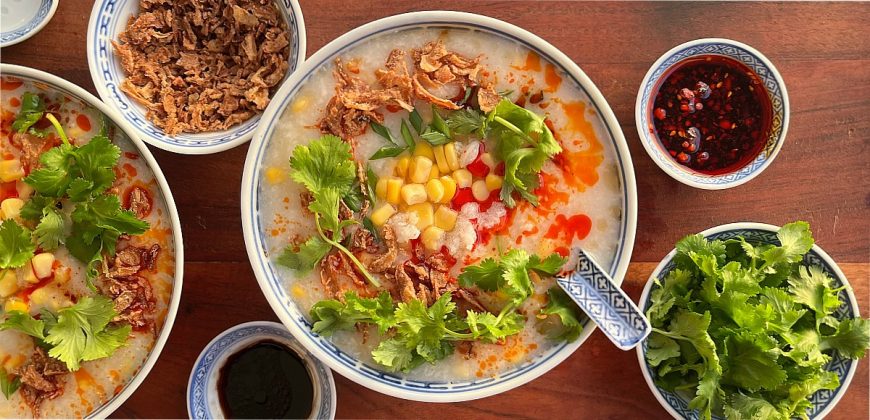
Our rice cooker congee recipe makes a corn and crab congee drizzled with sesame oil and chilli oil, sprinkled with crunchy fried shallots, and garnished with fresh coriander and spring onion. It’s addictively delicious, incredibly comforting and super versatile. Use this basic rice cooker rice porridge recipe, a cheat’s congee recipe, to make a Southeast Asian style rice porridge with any kind of seafood, fish, chicken, pork, or vegetables, and garnish with your favourite herbs and condiments.
If you’re a congee lover and don’t have time to make congee from scratch, which requires keeping an eye on a pot simmering on the stove and giving it an occasional stir, try my cheat’s congee recipe, one of my favourite rice recipes. This easy set-and-forget rice cooker congee recipe makes a deliciously simple corn and crab congee with pantry staples – if you’re like me and keep canned crab and corn kernels in the kitchen cupboard – but the recipe is versatile.
This is the recipe I use when I need comfort food and I’m too tired to do anything but add rice and water to a rice cooker, open a couple of cans, and prep a few ingredients. But you can easily elevate this congee by swapping the canned crab and corn kernels for fresh crab meat and corn sliced off boiled corn cobs. Or skip the crab and use prawns or fish, shredded chicken, pork, or vegetables, and top with your favourite fresh herbs and condiments.
If you’re a fan of rice bowl meals, we’ve got more recipes for rice porridges and rice soups, including recipes for Cambodian chicken rice porridge, vegetable congee and rice soup with pork meatballs, a Thai rice soup with shredded chicken, and my East-West experiment, a bacon and eggs breakfast congee. If you’re a rice lover, also check out our guide to how to cook rice around the world, with recipes and tips from 66 rice cooking experts: chefs, cookbook authors, food writers, bloggers, home cooks, and a MasterChef contestant.
Now before I tell you more about this rice cooker congee recipe for a cheat’s rice porridge, I have a favour to ask. Grantourismo is reader-supported. If you’ve enjoyed our recipes, please consider supporting Grantourismo. You could buy a handcrafted KROK, the best mortar and pestle ever; or book a cooking class or meal with locals on EatWith; or buy something on Amazon, such as these cookbooks for culinary travellers, classic cookbooks for serious cooks, or gifts for Asian food lovers and picnic lovers.
Looking for more cooking inspiration? We’ve got thousands of recipes in our archives from around the world from places we’ve lived, worked, travelled, and loved. And note that you can save your favourite recipes in a private account by clicking on the heart on the right of the post. Now let’s tell you all about our rice cooker congee recipe for a deliciously addictive corn and crab congee.
Rice Cooker Congee Recipe for Corn and Crab Congee
In Southeast Asia, congee or rice porridge is traditionally made from scratch in a pot on the stovetop. Although in Cambodia, where we’ve lived for 15 years, rice porridge is also cooked in a clay brazier directly over an open fire, as it historically was, especially in the countryside.
These days, in towns and cities, home cooks also make rice porridge in a rice cooker, and not even a sophisticated rice cooker with a porridge setting, just a very basic rice cooker. It’s for a basic rice cooker that I’ve created this rice cooker congee recipe, which will make you an incredibly delicious corn and crab congee or rice porridge with pantry staples.
If you’re new to Asian congee or Southeast Asian congee in this case, note that congee and rice porridge are exactly the same. I’m just using the terms interchangeably. Rice soup is a thinner version of rice porridge. Some people find rice porridge to be too heavy and prefer rice soup to rice porridge, as it’s lighter and less filling. Although with a rice soup the garnishes tend to sink into broth rather than sit prettily on top.
In Asia, a rice porridge was traditionally eaten for breakfast or served to someone who was feeling sick. But these days, like noodle soups, rice porridges are eaten at any time of day or night: for breakfast, brunch, lunch, a snack, dinner, or supper. Congee is also considered to be a fantastic hangover cure.
While my rice cooker rice porridge recipe calls for pantry staples, as it’s intended to be an easy weeknight meal, you can certainly elevate this congee with good quality fresh ingredients to make a more luxurious congee, like the heavenly rice porridge that Christine Manfield’s pork and crab congee with XO sauce recipe makes.
The toppings are essential, just as they are in a noodle soup in Southeast Asia. So make sure to drizzle the congee with sesame oil and/or chilli oil, sprinkle on some crunchy fried shallots, and garnish with fresh coriander and spring onion slices. Or your favourite combination of herbs and condiments.
Just a few tips to making this rice cooker congee recipe for a cheat’s congee as it’s an easy set-and-forget recipe that’s super versatile.

Tips to Making this Rice Cooker Congee Recipe for Corn and Crab Congee
I only have a few tips to making our rice cooker rice porridge recipe for a corn and crab congee, starting with the ingredients and substitutes.
Ingredients
As this recipe is super versatile, let’s look at the ingredients and how you can easily substitute them and use whatever you have on hand.
Rice
My rice cooker congee recipe calls for jasmine rice, a fragrant long grain rice, as we live in Southeast Asia where jasmine rice grows and jasmine rice reigns supreme. Jasmine rice is always used for rice porridge and rice soup, which is either made from scratch or made with leftover rice.
Note that despite what you might read in some places on the internet, jasmine rice is not the same as sticky rice, which is glutinous rice. When steamed, jasmine rice can be sticky. Roll a ball of steamed jasmine rice between your fingers and it will stick to them, but that does not make jasmine rice ‘sticky rice’.
Of course, you could use the short grain Japonica rice, commonly known as ‘sushi rice’, which is used in Japan and Korea, and breaks down more quickly. Note that while glutinous rice is a variety of Japonica rice, you want a non-glutinous rice for a savoury rice congee. A glutinous rice is better suited to a sweet rice porridge.
Lemongrass and Ginger
Use fresh lemongrass and ginger if you can source them. At home in Siem Reap, we always use fresh ginger and fresh lemongrass, which are available year-round and in abundance and affordable at the local markets and supermarkets. Lemongrass grows like weeds and almost everyone grows lemongrass in their garden.
However, I’m currently in a small city in rural southern Australia, where cold weather for most of the year means that fresh lemongrass and fresh ginger aren’t always available, unlike, say, tropical Darwin and northern Queensland, where they’d be more readily available. When I do spot them in the supermarket, they’re stupidly expensive.
I’m fortunate enough to have a handful of specialist Asian grocery shops within a few blocks walk, and all have frozen lemongrass, also expensive, which I can’t bring myself to buy. Australian supermarkets all have Asian sections, which usually have sliced lemongrass and finely diced ginger in jars, as well as ground ginger in the spice sections.
We can also get dried lemongrass and ground lemongrass in Cambodia, which I haven’t spotted it here. But other aromatics also work. Star anise is wonderful.
Crab Meat and Corn Kernels
The cost of canned crab meat varies dramatically so use the best quality canned crab meat you can afford. If you want to elevate the dish, buy fresh crab claw meat from the supermarket seafood section or a fishmonger. Here in Australia, crab claw meat is also sold in plastic tubs in the cold section alongside the smoked salmon and caviar.
I intentionally created this rice cooker congee recipe for those times when you want a bowl of comforting rice porridge that you can whip up with pantry staples. But if you really want to elevate the dish and you’re using fresh crab meat you could also use fresh corn cobs. You can cook them in the rice cooker with the rice porridge or boil them separately and slice the corn kernels off the cobs.
You can also swap the crab meat and corn for any kind of seafood, fish, chicken, pork, or vegetables, and garnish with your favourite herbs and condiments. We’ve long made rice porridge with shredded poached chicken. If you’re sticking to pantry staples, another combination I’ve tried and loved are shrimps/prawns and peas, with frozen peas and either canned or frozen shrimps/prawns.
Fish Sauce
We love Thailand’s Megachef fish sauce for its quality and consistency. It’s easy to find in Australia, although you can buy it online. Some of our American readers say they prefer the American-Vietnamese brand Red Boat Fish Sauce. We haven’t tried it as we’ve never seen it in Southeast Asia.

Instructions
This is a step by step guide to making my rice cooker congee recipe.
Rinse the Rice
To a fine mesh strainer, add a cup of jasmine rice and rinse the rice under a tap of running water for 30 seconds or so. You only want to remove any impurities. You don’t want to wait until the water runs completely clear because unlike with some other dishes, you actually want some starch to thicken the rice porridge.
Cook the Rice
If you have a fancy rice cooker with multiple settings, including a ‘rice porridge’ or ‘porridge’ setting, simply following the instructions and levels within the rice cooker. The instructions below apply to a very basic rice cooker with no settings.
To your rice cooker, add the washed rice, 3 cups of water, lemongrass, ginger, and fish sauce, stir well, put the lid on, and turn on the rice cooker. If you have a super basic rice cooker like I’m currently using, simply turn the rice cooker on.
If the rice cooker starts to bubble vigorously and the lid jumps around and rice liquid splutters out of the hole in the lid, just loosely lay a cotton tea towel on top of the lid. A sophisticated rice cooker with a ‘rice porridge’ or ‘porridge’ setting shouldn’t do this if you’ve followed your rice cooker instructions, but a basic rice cooker probably will.
When the rice cooker turns off, leave it to continue steaming for a few minutes, remove the lid, and stir the rice porridge. If you’ve got a fancy rice cooker your rice porridge should be perfect.
If you have a super basic rice cooker and you don’t have a rice porridge texture and what’s in the rice cooker is more like wet steamed rice, add another cup of water (or more as needed; every rice cooker is different), stir, close the lid, and allow it to cook for a few more minutes (or as needed).
When you have the right texture, add almost all the crab meat, including brine, and almost all the corn kernels, saving the equivalent of a tablespoon of each of the crab meat and corn kernels per bowl for garnishing. Stir in thoroughly, add another cup of water if needed, stir, close the lid, and turn it on again. Allow it to cook for a few more minutes then it should be ready!
Serve the Rice Porridge
When the congee texture is to your liking and you’re ready to serve it, ladle the rice porridge into bowls, drizzle with sesame oil and/or chilli oil (if you know your guests), sprinkle with crunchy fried shallots, and garnish with spring onion slices and fresh coriander sprigs. Serve immediately with more dishes of condiments and fresh herbs so guests can customise their congee.
In Southeast Asia, rice porridges are always customised. Street food vendors, market stalls and eateries provide a condiment tray or condiment caddy on every table or at the stall to be passed between diners. Sometimes a basket of fresh herbs will also be provided on the table for people to pluck off leaves and sprigs as they like, especially for dishes such as nom banh chok in Cambodia and Lao khao soi in Laos.
If I was preparing this rice cooker congee for Terence and myself, we’d just help ourselves to condiments, but if I was serving this to guests, I’d provide a caddy of chilli oil, chilli crisp, fish sauce, soy sauces, and homemade Sriracha, and dishes of crispy fried shallots, chilli flakes, maybe sesame seeds, and fresh herbs so people could add adjust their bowls of congee to their liking.
Rice Cooker Congee Recipe for Corn and Crab Congee

Equipment
Ingredients
- 1 cup jasmine rice - rinsed
- 4 cups water - or as per your rice cooker indicator, and more as needed
- 1 stalk lemongrass - white end only, finely sliced, or 1 tsp ground lemongrass or lemongrass paste
- 1 piece fresh ginger - cut into 3-4 pieces, or 1 tsp ground ginger, or ginger paste
- 1 tsp fish sauce
- 170 g can crab meat - or fresh crab meat, and brine
- 420 g can corn kernels - or fresh corn sliced off cobs
- 1 tbsp sesame oil
- 1 tbsp chilli oil - or chilli crisp
- 2 tbsp crunchy fried shallots
- 1 spring onion - finely sliced
- 1 cup fresh coriander sprigs
Instructions
- To a fine mesh strainer, add a cup of jasmine rice and rinse under a tap of running water for 30 seconds or so just to remove any impurities. No need to wait until the water is completely clear because you want some starch to thicken the rice porridge.
- To your rice cooker, add the washed rice, 3 cups of water, lemongrass, ginger, and fish sauce, stir well, put the lid on, and turn on the rice cooker — or set to ‘rice porridge’ if you have a sophisticated rice cooker. If the rice cooker starts to bubble so vigorously, the lid jumps up and down and liquid splutters out of the hole (this doesn’t happen with all rice cookers), loosely lay a cotton tea towel on top of the lid.
- When the rice cooker turns off, leave it to continue steaming for a few minutes, remove the lid, and stir the rice porridge. If you don’t have a rice porridge texture and what’s in the rice cooker is more like wet steamed rice, add another cup of water or more as needed; every rice cooker is different. Stir, close the lid, and allow it to cook for a few more minutes.
- To the rice cooker, add almost all the crab meat, including brine, and almost all the corn kernels, saving the equivalent of a tablespoon of each of the crab meat and corn kernels per bowl for garnishing. Stir in thoroughly,
- add another cup of water if needed, stir, close the lid, and allow it to cook for a few more minutes.
- When the congee texture is to your liking and you’re ready to serve, ladle the rice porridge into bowls, drizzle with sesame oil and/or chilli oil, sprinkle with crunchy fried shallots, and garnish with spring onion slices and fresh coriander sprigs. Serve immediately with more dishes of condiments and fresh herbs so guests can customise their congee.
Please do let us know if you make our rice cooker congee recipe for a quick and easy corn and crab congee, as we’d love to hear how it turns out for you.