Our one day in Hue itinerary outlines our idea of a perfect day in Hue, Vietnam’s former imperial capital. Our itinerary begins with a bowl of Hue’s quintessential breakfast before exploring Hue’s UNESCO World Heritage-listed sights — the spectacular Citadel, Imperial City and mosaic covered palaces, pavilions and temples — followed by a mouthwatering lunch at a local favourite, an afternoon tomb-hopping in the forested hills around Hue, a sunset cruise on the Perfume River, and an evening savouring Hue’s unique street food and imperial cuisine.
As I said in the intro to our guide to where to stay in Hue in Central Vietnam — and I know I risk sounding like a broken record, because I say this about a lot of the places we love in Southeast Asia that get overlooked by travellers — but you could easily spend a week in Hue. One of Southeast Asia’s loveliest riverside cities, there are so many things to do in Hue, pronounced H-way. I’d happily live in Hue if we could.
Set on the banks of the beautiful Perfume River, Hue brims with UNESCO World Heritage-listed monuments, from the majestic Citadel and captivating Imperial City to the flamboyant tombs of the Nguyễn Dynasty emperors scattered around the city and the surrounding wooded hills. Bonus: Hue has fantastic street food, lively local markets, a unique imperial cuisine, and excellent cooking classes, some set in enchanting heritage garden houses.
Sadly, most foreign travellers to Vietnam only spend one day in Hue. And that day in Hue is often tagged onto a longer stay in Hoi An or a beach resort on the coast near Hue. So we thought we’d try to persuade you to spend more time in Hue. We’re starting by sharing a one day in Hue itinerary for our idea of a perfect day in Vietnam’s storied imperial capital. Then we’ll share itineraries for a weekend in Hue and three days in Hue.
Now, before you scroll down to our one day in Hue itinerary, we have a favour to ask. Grantourismo is reader-supported. If you find our itineraries helpful in planning trips, please consider supporting our work: you could use our links to buy travel insurance; book flights, accommodation and car rentals on Booking.com, Agoda, Expedia, ebookers, CheapOair, Kiwi, Trip.com or Wotif; book transfers, tickets and tours on Get Your Guide; buy bus and train tickets on 12Go; or book a cooking class or meal with locals on EatWith. We may earn a commission, but you won’t pay extra.
One Day in Hue Itinerary – How to Spend a Perfect Day in Vietnam’s Old Imperial Capital
As I said in our guide to where to stay in Hue, seems like everyone is heading to Vietnam. But most people I’ve talked to are going to Hanoi, Hoi An and Saigon, doing a Mekong Delta day trip, then heading onto Phnom Penh and Cambodia, our adopted home. (Yay!) Many are doing a Halong Bay cruise, some going up to Sapa, but I don’t know anyone including Hue on their itineraries — or, for that matter, some of our other favourite Vietnam destinations: Dalat, Mui Ne and Nha Trang.
It reminds me of when Australians started travelling en masse to Thailand in the 1980s. Typical itineraries took in Bangkok, Hua Hin, Phuket, and Chiang Mai. Some went to Koh Samui, those who flew direct to Phuket added a nearby island or two, while road trip lovers hired a car in Chiang Mai and drove up to Chiang Rai. It was a while before travellers started island-hopping and venturing to more off-the-beaten-track areas such as the northeastern Isaan.
But travellers have been visiting Vietnam since the 1990s, so what’s taking them so long to venture beyond the most popular places? Danang and Phu Quoc are now well and truly on tourists’ radars thanks to some aggressive marketing, but while I have a soft spot for Danang, Hue is definitely worth your time and so much more than an add-on to a Hoi An stay or a day trip from that dreamy riverside port town.
What I love about Hue is that it has something for everyone, whether you’re a street food enthusiast, passionate cook, history buff, fan of culture, art and architecture, or a nature lover — or you just love the idea of kicking back in a relaxed little city set on a beautiful river, surrounded by forested hills and mountains, with a stunning coast with sandy beaches and serene estuaries a short drive away.
There’s easily enough to keep you occupied in Hue for a week or more, but as most travellers don’t have that much time, we’re going to share itineraries for a few days in Hue, a weekend in Hue, and, starting today, our one day in Hue itinerary. Follow our itinerary for how to spend a perfect day in Hue and you’re guaranteed to have a very memorable time in Hue. But first…
Hue Itinerary Tips
Before you scroll down to our one day in Hue itinerary, here are a few Hue itinerary tips based on our experience:
- You really do need a full day in Hue: please don’t try to squeeze this itinerary into an afternoon. Do try to arrive on an early morning flight, store your luggage at your hotel (don’t wait until your room is ready) and head out straight away, or…
- If you’re travelling overland and arriving by train on the Reunification Express from Hanoi or Vinh in the north or from Danang in the south, or by road via a transfer over the Hai Van Pass, try hard to arrive in Hue the afternoon or evening before this Hue itinerary starts.
- Start your one day in Hue as early as you can, around 6-7am ideally, before it gets too hot and Hue’s sights get too crowded with local tourists. Hue is worth the early wake-up.
- Don’t leave the hotel without slipping on super comfy walking shoes, rubbing on sunscreen, and popping on a brimmed hat. Hue gets hot and you can’t avoid walking in the blazing sun at many of Hue’s star sights.
- Don’t be surprised if you don’t fall in love with Hue your first trip. Hue grows on you the more time you spend there. It’s been over repeat visits over many years that our affection has grown for the laidback city with leafy promenades, wide river, illuminated bridges, and wooded hills.
Getting to Hue
Before you jump into our one day in Hue itinerary, you’ll need to decide how you’re getting to Hue (ideally you want to arrive the afternoon/evening before this itinerary starts) and where you’re going to stay in Hue, although getting around Hue is fairly easy and nothing is too far away.
How to Get to Hue
Our one day in Hue itinerary assumes you’re starting your day in Hue early in the morning, so if you only have one day, you definitely want to arrive into Hue the afternoon before our itinerary begins, and there are a few great transport options for getting to Hue.
Flying to Hue
Flying to Hue is the best way to arrive if your schedule is tight. Vietnam Airlines and VietJet operate flights from Hanoi to Hue (1 hour 15 minutes) and Ho Chi Minh City to Hue (1 hour 25 minutes).
Phu Bai International Airport (HUI) is some 15kms (9 miles) from Hue and takes around 20-25 minutes depending on traffic. I book an airport transfer from Phu Bai to Hue on Get Your Guide. You could also book a Grab on arrival if you’re using an eSIM.
Overland to Hue
If you’re travelling overland to Hue from Hoi An you have two options: road or train.
By Road to Hue
Travelling by road, we love the slow drive, taking Vietnam’s most scenic route over the breathtaking Hai Van Pass over the fast way, which takes you through a tunnel beneath the mountain. You could travel via a private transfer in a van or car, depending on the how many of you there are, or hop on a cheaper Hoi An-Hue shuttle bus.
Travelling from Hoi An to Hue via motorbike on the Hai Van Pass is also popular, especially with backpackers. However, having lived in Hoi An, where we were hassled on a daily basis by the motorbikes guys spruiking their services, we’re not fans. Plus a motorbike is not so convenient when it comes to me taking notes and Terence carrying a lot of expensive camera gear, so professionally it’s not been an option.
Our preference and recommendation is still taking the Hai Van Pass route but booking a private Hoi An-Hue transfer so you have flexibility and can have your driver stop when you want to gawk at the gobsmacking views and bypass the more touristy stops that you’re not interested in. The journey takes 3 hours (no stops) to 4-5 hours (depending on number of stops)
By Train to Hue
If you’re a train lover then the Danang-Hue section of the Reunification Express train, which runs the length of Vietnam from Saigon/Ho Chi Minh City-Hanoi, is a must. It travels close to the dramatic coast and sea, hugging the hillside for some of the 2.5 hour journey. (I’ll be sharing a guide to the Reunification Express soon.) If you’re coming from Hoi An, you need to get a transfer to the train station at Danang (also worth a day or two.)
Best Hue Accommodation for One Night
With only one day in Hue, you’ll want to check into one of the best hotels in Hue and for us that not only means a central location, but a hotel as memorable as this romantic city. Fortunately, you’ll find some of Vietnam’s most reasonably priced accommodation in Hue in every category, style and budget. So if you’re on a tight budget, Hue could be the city where you splurge on a fancier hotel that’s actually affordable.
These are our picks of Hue’s best accommodation if you only have one night, all tried and tested (some multiple times) over 15 years living in Southeast Asia, including Vietnam. We’ve included lots more lodgings for every budget, and more detailed reviews, in our Hue accommodation guide.
Where to Stay in Hue — Check Into Charming Lodgings
Riverside Hue is such a romantic city you don’t want to ruin your experience by staying in characterless accommodation, especially if you’re only staying one night in Hue. These are our picks of Hue lodgings: if they don’t ooze history (Azerai La Residence, Ancient Huế Garden Houses), they have atmosphere (Pilgrimage Village Resort and Spa), style (Alba Spa Hotel) or charm with the kindness and warmth of the hosts (Lavande Hue Homestay).
Tip: If you’re flying into Hue and not travelling overland to Hue from Hoi An, check the Hue accommodation listings carefully on the hotel booking sites when you’re making a reservation to see if your Hue hotel offers an airport shuttle service, and if it’s a complimentary airport shuttle.
Azerai La Residence Hotel Hue
The handsome Azerai La Residence Hotel Hue is our top pick if you only have one day in Hue. One of the best luxury boutique hotels in Central Vietnam, the splendid Azerai is slap-bang on the banks of the Perfume River, overlooking Hue’s UNESCO World Heritage listed Citadel and Imperial City. Located on Le Loi Street, it’s perfect for walking everywhere, if the weather allows; if it doesn’t, the hotel can organise tours and taxis.
La Residence was where we stayed on our first visit to Hue way back in 2012, just seven years after this Art Deco gem’s first meticulous restoration. The spacious rooms are super comfy but the public spaces are so beautiful with their retro furniture, vintage lamps and terrazzo floors, we spent more time at the bar, playing billiards, and dining on the restaurant terrace, overlooking the stunning 30 metre saltwater swimming pool. Book Azerai La Residence Hotel Hue with our booking partner.
Ancient Huế Garden Houses
Located on the other side of the Perfume River, away from the hustle and bustle of busy downtown Hue, in the quiet, leafy, historic Kim Long neighbourhood, the enchanting Ancient Huế Garden Houses are a half hour’s stroll to the Citadel and Imperial City or a 5- to 10-minute drive if you’re not yet accustomed to the heat or can’t face crossing busy Lê Duẩn road. These are Hue’s most romantic lodgings, but rich in history, the neighbourhood is also fascinating to explore.
The five restored Garden Houses with hardwood pillars and exposed beams are exquisitely decorated with carved screens, mother-of-pearl inlaid furniture, and terraces overlooking ornate gardens and pool. If the hardwood Houses are too dark for you, there are four light-filled colonial-style French Villas with balconies overlooking another pool. Make sure to dine in at least once. The food is divine! Book Ancient Huế Garden Houses with our booking partner.
The Pilgrimage Village Resort and Spa
Located in peaceful Thua Thien Hue, on the outskirts of Hue, just a 5- to 15-minute drive to the Perfume River and Hue’s city centre, Hue’s Pilgrimage Village Resort and Spa is my other favourite hotel in Hue. Set within lush gardens and surrounded by forest, lodgings include a combination of spacious brick bungalows, villas and rooms with four-poster beds, pretty tiled and slate floors, and balconies or terraces, many with private plunge pools.
While I wouldn’t normally include lodgings that aren’t in the city centre in a one-day itinerary, the beautiful resort is in a fantastic location for forays into the forested hills surrounding Hue to visit the mosaic-covered tombs of Khai Dinh, Tu Duc and Minh Mang, monasteries and villages, and has two big gorgeous swimming pools to cool off after those sweaty excursions. The resort offers a complimentary shuttle bus into Hue and can book taxis for you. Book The Pilgrimage Village Resort and Spa Hue with our booking partner.
Alba Spa Hotel
The only high-rise hotel I’ve included in this one day itinerary, Hue’s Alba Spa Hotel has lots of character for such a modern hotel. Expect arty design touches such as illustrated murals on doors, a bamboo-lined lobby, potted tropical plants, and a small but lush spa with vertical garden and plunge pool.
Best of all, the light-filled rooms with balconies and gob-smacking views are an absolute bargain out of high season, and the location is excellent, just a few blocks from the Perfume River and heart of Hue’s downtown area, with a few of Hue’s best eating spots a short stroll from the hotel. Book Alba Spa Hotel Hue with our booking partner.
Lavande Hue Homestay
The comfy Lavande Hue Homestay is a brilliant option if you’re travelling on a budget, prefer not to spend a lot of money on fancy accommodation, and appreciate a warm welcome and personable service, like someone to help carry your bags upstairs, book transport and tours, and provide local tips.
There are loads of restaurants and bars within walking distance and the compact rooms are clean and comfortable with big windows and balconies, some with stylish modernist furniture. Every room has air-conditioning, free wi-fi, private bathroom, a table and chairs, and desk; they’ll store luggage; and there’s space for your bicycles if you rent them. Book Lavande Hue Homestay with our booking partner.
How to Spend a Perfect Day in Hue
To experience all of our one day in Hue itinerary, head out for breakfast in Hue around 6.30-7am, or 7.30-8am at the latest — earlier is better to beat the heat, the tour groups, and day-trippers from Hoi An heading to Hue’s star attractions. Plus local markets are always livelier in the early morning and the food is fresher and better the earlier you go.
Breakfast in Hue — Slurp a Big Bowl of Bun Bo Hue
As you only have one day in Hue, you have to try the most quintessential Hue breakfast, a big bowl of bún bò Huế. ‘Bún’ are rice noodles and ‘bò’ is beef, but bún bò Huế isn’t your average beef noodle soup. Vietnam’s spiciest soup thanks to dried spices and fresh chillies, a great bún bò Huế begins with a fragrant, deeply-flavoured, slow-simmered beef bone stock.
Bún bò Huế is funky courtesy of shrimp paste and fresh, tangy and aromatic due to lemongrass, Vietnamese mint and lime. While beef is the star of the flavour-packed broth, cooks distinguish their bún bò from the next with additions such as pork knuckle or blood cake. Garnish with the fresh herbs and sprouts provided, along with more chilli if you like (often on the table in the form of fresh chilli slices, sauce and/or flakes), fish sauce, and a squeeze of lime.
You can find great bún bò all over Hue. But we’ve slurped some of our most memorable bowls sitting on tiny plastic stools at stalls at Hue’s local markets, including Dong Ba Market, widely considered Hue’s best market — which is where the street food-loving chef cum food show presenter Tony Bourdain first tried bún bò Huế and pronounced it “the greatest soup in the world”.
Dong Ba Market is also convenient if you’re following our one day in Hue itinerary and setting out early in the morning for the Imperial City, as it’s on the same side of the river and just a 5-minute drive or 20-walk minute walk. Bourdain’s favourite stall is just inside the main entrance to the market (you can’t miss it; it’s the busiest), but we like to spread the love, and there are more bún bò stalls deeper inside the market that are just as good.
If you can’t face rising early for a market breakfast, you could ask your hotel staff to recommend the best bún bò place near your lodgings that they love to eat at. That’s how we’ve found some of the best eating spots in Hue. Dong Ba Market is also a fab destination to eat in the evening when the footpaths outside the market are crammed with little pop-up stalls with locals perched on tiny stools slurping and munching from sunset onwards.
Morning in Hue — Amble the Atmospheric Imperial City
A perfect one day in Hue itinerary has to begin with a morning spent ambling the breathtaking grounds of the magnificent old Imperial City of Hue (open 7am-5.30pm). It’s a massive site, which is essentially a citadel within a citadel, with some 20 buildings inside 2.5km-long walls, so do allow plenty of time for a proper experience of the place.
A visit to the Imperial City can take anything from a brisk 2-hour walk with a tour guide on a Hue City Highlights Tour that takes in the citadel, pagodas and royal tombs to a more leisurely 3-4 hours if you hire a guide for a private tour or you visit independently, you’re a completist and want to see everything, or you simply want to take time to absorb the attraction at a slower pace. I’ve been to the Imperial City a handful of times and enjoy it more each time.
And do make sure to wear sunscreen, comfy shoes and a hat to avoid heatstroke. There are lots of vast exposed areas to cross between compounds and buildings with few chances to shelter from the scorching sun. So do take advantage of opportunities to rest on a seat in the shade of a cool breezy corridor or take time out to watch a show in the sumptuous theatre.
Hue was established as the capital of a unified Viet Nam in 1802 by Nguyễn Ánh, who proclaimed himself Emperor Gia Long, and built the sprawling walled complex of paved courtyards, palatial residences and elegant pavilions, located within the wide moat and imposing defensive walls of a magnificent Citadel.
Hue would remain the Imperial Capital from 1802 to 1945 but it was not only the political centre of Vietnam, it was also the cultural and religious centre of Vietnam under the Nguyễn dynasty, the last royal dynasty. That explains the gobsmacking size and grandeur of the former Imperial City, as well as why there are so many richly decorated mausoleums, tombs and pagodas dotted around Hue, on the riverside and in the surrounding hills.
That’s also why Hue was awarded its UNESCO World Heritage designation for a whole Complex of Hue Monuments in addition to the Imperial City. That complex includes the Van Mieu (Temple of Literature), the Dan Nam Giao (Esplanade of Sacrifice to the Heaven and Earth), the Ho Quyen (Royal Area), the Den Voi Re (Temple of the Roaring Elephant), and the Chua Thien Mu (Celestial Lady Pagoda), as well as the tombs of Nguyễn Dynasty emperors.
Having said that, the Imperial City, and the splendid Forbidden Purple City within it, are the star attractions of the constellation of treasures scattered across Hue. That’s not to say, you shouldn’t try to experience them all. You should! But you won’t squeeze them all into one day in Hue. You’ll need to extend your stay, or plan to return.
Sadly, most of the original 148 buildings in the Imperial City were badly damaged during the Vietnam War (which the Vietnamese call the American War, for obvious reasons), especially during the 1968 Tet Offensive and month-long Battle of Hue, and no longer exist or are in a ruinous state. Bullet holes can still be seen in the reconstructing buildings and guides will point out the bullet holes to you on a tour.
Another thing I love about a good guided tour is the chance to get a Vietnamese language lesson and learn the correct pronunciation of names, especially if you’re visiting Vietnam for the first time. It was on a Hue Imperial City tour many years ago that I learnt that ‘Nguyễn’ is pronounced ‘Ng’win’, with the ‘ng’ sounding like the ‘ng’ in song. Hard to get your tongue around that one, but I realised I’d been mispronouncing Aussie-Vietnamese chef Luke Nguyen’s name ‘New-yen’ for years!
Guides also look to provide an introduction to feng shui on Hue Imperial City tours, as its elements are so intrinsic to the design of buildings and gardens in Hue, such as the use water in the form of fish ponds and fountains for calm and relaxation (there’s water everywhere in the Imperial City), and the use of certain flowers and plants, especially bonsai (in abundance in the ornate gardens) which represents harmony and happiness.
You can also expect to hear plenty of birdsong (I wrote “birdsong!” six times in my notebook during my last visit), so make sure to take time out from your tour guide’s chatter to sit and listen for a while.
If your guide is like the guides we’ve used, you’ll also get an intro to lucky numbers. On my last Imperial City tour with local guide Ken, he told us: “Three represents harmony, and is used a lot in Hue architecture, four represents the seasons, five is balance. Add four and five together, and you get nine, the best number. Locals love nine in Hue. All my friends choose mobile numbers with a lot of 9s.”
According to Ken, the last emperor adored architecture, art, literature, poetry, and love (he had 103 concubines apparently, but no children), and had no interest in war — “which is why,” Ken explains, “they lost all the battles and provinces and why Vietnam became a French colony.”
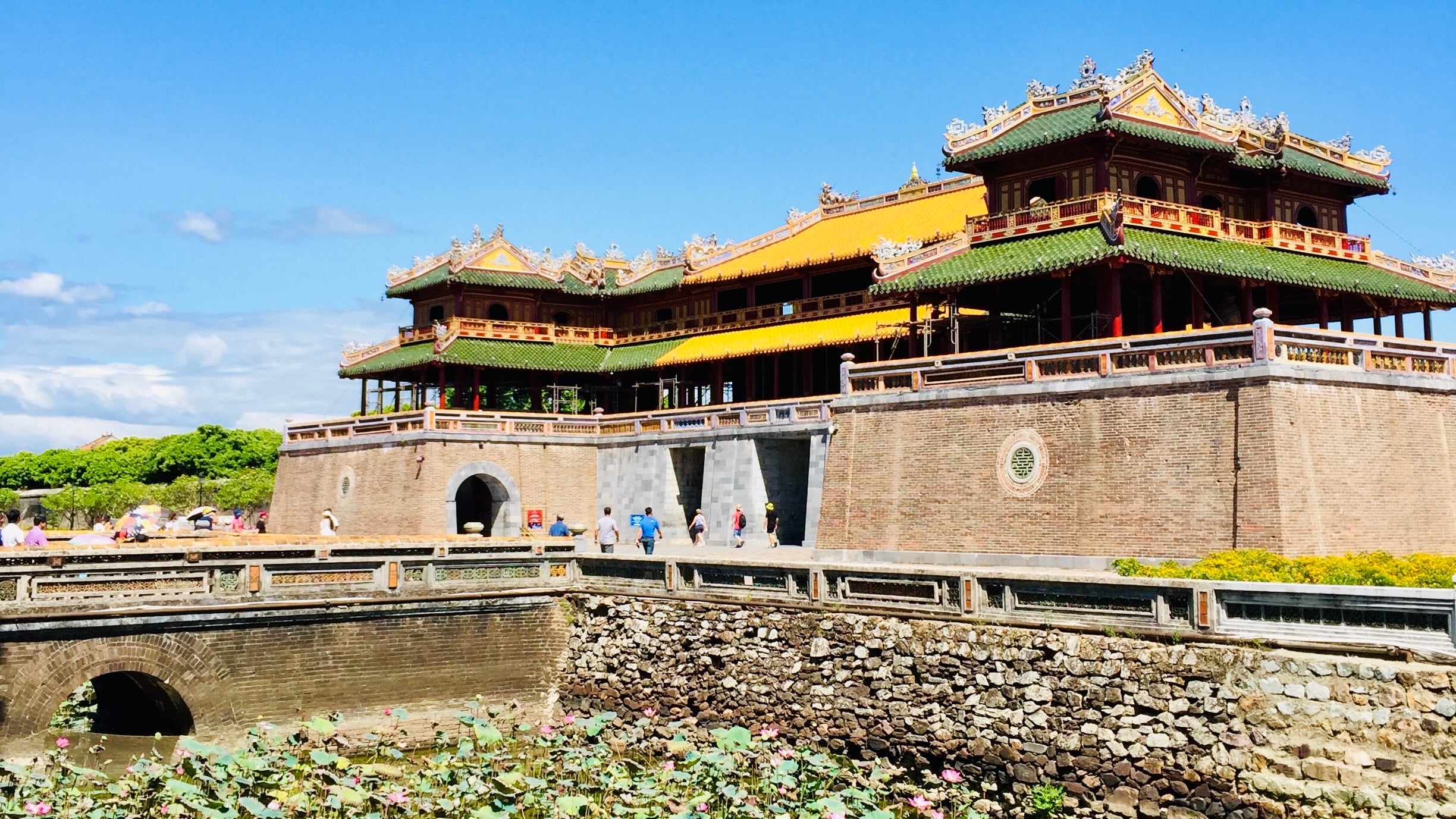
Whether you visit Hue’s Imperial City on a guided tour or independently you’ll begin at the majestic Ngo Mon Gate or Meridian Gate, above, also known as the South Gate, modelled after the Meridian Gate of Beijing’s Forbidden City in China. Most visitors rush inside, eager to get started, but do take a moment to admire the handsome structure and take a snap if you arrive early and beat the tour groups.
Other highlights of the Imperial City for us include the Thai Hoa Palace (Palace of Supreme Harmony) with its 80 red lacquered columns and carved shutters; the mosaic-covered Emperor’s Reading Room or Royal Library, the only building to survive the wars; the lemon-coloured Dien Tho Residence of the Queen Mother (yellow represents success in feng shui, which explains why yellow dominates Hoi An, where merchants dreamt of prosperity); and the majestic Royal Theatre. Many buildings are embellished with mosaics; look out for the pretty ceramic tiles illustrating an apricot, lotus, chrysanthemum, and bamboo, representing the four seasons.
Lunch in Hue — Graze on Smoky Succulent Grilled Pork
If you only have one day in Hue, then you have to eat at our favourite lunch spot in Hue, Huyền Anh (52 Kim Long Street, Hue). Located on a lane off the riverside Kim Long road, on the edge of the historic Kim Long neighbourhood, Huyen Anh is just a 5-minute drive from the Imperial City. It’s not only super-convenient if you’re hot, tired and hungry, the food is incredibly delicious so you’ll be well sated before your afternoon rest.
When we first ate at Huyen Anh way back in 2012 on our first trip to Hue, we checked into La Residence across the river in the early afternoon. As we didn’t want to miss out on lunch, we asked the hotel reception staff for tips. I distinctly recall them sliding a page of hotel stationery across the reception desk with a typed list of recommendations the European general manager had compiled.
Nothing appealed — everything looked too touristy — so we asked where they liked to eat. The staff looked at each other, one pulled out a map from beneath the counter, circled a spot, and wrote Huyen Anh. We asked them to call a taxi and ten minutes later we were sitting on blue plastic chairs in the modest family-owned eatery sipping Huda beers, appreciating the groovy graphics on the cans as much as the icy-cold lagers.
Little more than a breezy space with baby blue-painted walls beneath an open-sided awning attached to the family’s peppermint-painted two-storey home, Huyen Anh was well and truly under the radar back then. Popular with Hue locals and Vietnamese tourists, foreigners rarely ate there — unless escorted by tour guides who actually cared what their clients ate, or they’d persuaded hotel staff to share their favourites spots, as we’d done.
As Huyen Anh’s popularity has increased, it’s been spruced up and whitewashed, with new locations added: there are now three Huyen Anh locations, with two modern eateries on the riverside road (Huyền Anh 2 and Huyền Anh 1 called Bánh Ướt – Bún Thịt Nướng Huyền Anh). Our guide Ken claimed the locations were renumbered to reflect where the owners preferred customers eat, but we still favour the laneway original, renamed Huyền Anh 3.
Because attached to the airy awning is the grilling room, where the house specialty of succulent smoky grilled pork, marinated for hours in fish sauce, lemongrass, garlic, and pepper, is cooked to order on wire grilling racks, turned by hand over flaming red coals, kept ablaze by a floor stand fan that’s seen better days.
Another thing that’s barely changed in all these years is the short menu. Consisting of just three dishes when we first ate at Huyền Anh all those years ago, the framed bảng giá (price list) on the wall listed: bánh ướt thịt nướng (fresh spring rolls filled with grilled pork), 18,000 đồng/đĩa (per plate); bún thịt nướng (grilled pork with room-temperature rice noodles), 22,000 đồng/tờ (per portion); and thịt nướng (the heavenly grilled pork that serves as the basis of all dishes) for 60,000 đồng/đĩa (for what was a very generous serve).
Only one dish has been added in recent years, and that’s nem lụi huế (Hue-style lemongrass pork skewers). Order one of each, as the prices also haven’t changed much over: the pork-filled spring rolls and pork with noodles are just 30,000 đồng each a plate, and the pork skewers 70,000 đồng.
Make sure to eat the pork with the crunchy salad greens, pickles, fragrant herbs, and a warm dipping sauce that’s a specialty of Hue. The funky condiment is made with pork liver, fermented soy beans, peanuts, and sesame seeds. Wash it all down with Huda beers.
Late Afternoon in Hue — Head for the Hills to Visit the Royal Tombs
To avoid the scorching early afternoon sun — and the heatstroke that can result from staying out sightseeing under its searing rays all day! — we strongly recommend a restorative post-lunch nap in the cool of your air-conditioned room, and if you’ve checked into a Hue hotel with a pool, a swim to revive you before you head for the hills.
Spend a few hours in the late afternoon exploring some of the splendid royal tombs in the picturesque woodlands around Hue. (If you’re staying at the Pilgrimage Village Resort and Spa you won’t have far to go.) With only one day in Hue, we recommend continuing on to sundowners on the river and an evening of street food feasting, so, depending on the time of year, you might want to take something to wrap around your shoulders if doing a cruise.
Do note that respectful behaviour (no shouting or loud conversations) and modest dress is expected when visiting the mausoleums and pagodas, which are sacred sites. That means no revealing or see-through clothes, and definitely no bikini tops or short shorts. If you’re taking children, make sure not to let them climb onto statues etc.
While you could hire a taxi to independently visit the tombs — perfect for travellers who aren’t a fan of guided tours who prefer to wander at their own pace and take time out to sit by a coi pond — those keen on learning more about Hue’s rich imperial history and want to cover quite a few tombs would benefit from a more structured guided tour.
There are countless tombs in various states of ruin and repair in and around Hue, in the forested hills and countryside. But with just one day in Hue, I wouldn’t recommend trying to visit more than three or four tombs and pagodas, and for slow travellers who like to take things easy, I’d suggest limiting yourself to two tombs.
One of the must-see sights is Thien Mu Pagoda, best known for its seven-storey, 21-metre high, octagonal-shaped tower, Thap Phuoc Duyn. Situated on a hill overlooking the Perfume River, with a dock on the water, the Buddhist pagoda can be visited on a sunset cruise — or admired from the deck of your boat (with a cold Huda in hand!) — so save that one for later.
I like to kick off the afternoon with the Tomb of Tự Đức, located on Van Nien Hill in Duong Xuan Thuong village, 5kms south of Hue. Because while it’s the largest site, at 20 hectares with some 50 structures, the sprawling pine forest and lush parklands offer plenty of opportunities to retreat from the heat on breezy bridges and beneath airy pavilions overlooking the tranquil lake.
Built between 1864 and 1867, it was designed by Emperor Tu Duc himself, the longest serving monarch (he ruled from 1848 to 1883), and something of an intellectual and romantic, who used it as a retreat while he was still alive. It’s one of the most impressive of the lavishly decorated mausoleums, which also means it’s one of the most popular. Fortunately the site is so big it’s easy to escape the crowds.
Next I like to visit the Tomb of Minh Mạng, a 20-minute 10km drive south, and another mausoleum that’s set in expansive parklands with serene lakes, only this one has cows grazing on its shady hillocks. Emperor Minh Mang, who ruled from 1820–1841, was the second emperor and fourth son of Emperor Gia Long.
Well-regarded by Vietnamese for his opposition to the French and contribution to Vietnam’s development and initiatives in administration, public works, education, he’s resented by surviving Chams for his conquest of Champa and by Khmers for this temporary annexation of Cambodia.
While the complex is considered a masterpiece of traditional Vietnamese architecture and the best reflection of the aesthetics of the Nguyen Dynasty period, and buildings are undeniably beautiful, one of the most impressive sights is the Honour Courtyard, with its 20 life-size stone statues of mandarins, soldiers, horses, and elephants.
It’s just a 10-minute drive northeast to Chau Chu mountain and the Tomb of Khải Định, also known as Ứng Mausoleum. The Nguyễn dynasty’s 12th emperor from 1916 to 1925, Khải Định, in contrast to Minh Mạng, was incredibly unpopular: a puppet of the French, he opposed independence, was accused of selling out his country, and lived a life of luxury while his people were exploited by the occupiers. Indeed, peasants’ higher taxes helped pay for his sumptuous mausoleum.
Having said that, it’s the opulence of Khải Định’s flamboyant mausoleum that makes the unpopular emperor’s tomb so popular. Fusing Vietnamese and European styles, including Gothic, Baroque and Neoclassical, it’s the unique and somewhat whimsical design, and ornate decorative details that make the monument so fascinating and so compelling.
There are a lot more tombs that you could visit, but realistically that’s all you can squeeze into an afternoon if you’re only staying in Hue for one day, so after you’re finished visiting the Tomb of Khải Định, have your tour guide or taxi driver take you to the riverside in downtown Hue.
Sundowners in Hue — Sip Huda Beers on a Dragon Boat Sunset Cruise
Hue’s Perfume River (Sông Hương in Vietnamese) snakes down from its sources in the forested Annamite mountains through Hue city to the South China Sea. Spend any length of time in Hue and it’s hard to resist the allure of the Perfume River — which in dry season ranges from a deep green to cobalt blue, but in wet season is often the colour of a Vietnamese iced coffee, especially after a storm.
No matter the time of year, come late afternoon the place to be is on the river. One of our favourite things to do in Hue is to hug icy cans of Huda beer at one of the countless cafes that dot the riverside promenades. Along with long lists of refreshing and often very creative juices and coffees (many topped with ice-cream or yoghurt), nearly every cafe sells cold beer.
But with only one day in Hue, you have to sip those Hudas on the deck of a colourful painted wooden dragon boat on a cruise on the Perfume River. While I like to book a Hue sunset cruise in advance — just so I don’t have to worry about missing out, especially in high season — you can also try your luck at the last minute by chartering a boat on the dock itself.
The big boats decked out in fairly lights tend to be reserved for dinner cruises with food, folk singing and costumed performers and usually booked in advance. The smaller wooden boats with dragon heads are the vessels you can charter for a private cruise. Operated by a family or couple who look like they live on board, they’ll have a small fridge stocked with cold beer, so don’t take anything but change and buy your bevvies on board.
The main dock is the Toa Kham Boat Station at 49 Le Loi Street, not far from Trang Tien Bridge. The dock is off a large car park where the sightseeing buses stop and there are fairly clean toilets in the white building. There are ATMS nearby, along with lots of cafes, bakeries, and street food stalls, but we recommend waiting for dinner.
Dinner in Hue — Savour Local Specialties on a Street Food Tour By Cyclo
With only one day in Hue, we highly recommend you embark on a mobile progressive dinner of sorts and book a Hue street food tour by cyclo. We know it’s a touristy thing to do, but it’s so much fun. If you’ve resisted the urge to do a cyclo tour in Vietnam so far, this is the time to give in. (Although I have to confess that I also like the Hanoi cyclo tours through the Old Town…).
There’s something special about seeing Hue from the seat of a cyclo, especially after dark when the city, citadel and bridges are illuminated by brightly coloured lights. It’s especially fun to drive through the citadel neighbourhood (magic at night!) and over Trang Tien Bridge, which really does cycle through different colours, you haven’t had too many Hudas.
I’ve tried a few Hue street food tours by cyclo over the years as I used to include them in my Vietnam culinary tours, and they’re all very similar and have all been good fun (depending on the guide), even if they weren’t the most in-depth food tours (again, that depends on the guide).
Cyclo food tours typically depart from near Trang Tien Bridge (convenient after a river cruise); start between 5pm and 6pm (but if you book a private street food tour you can set the pick-up time in consultation with the guide and start a bit later if needed); begin with a bite at one of the evening stalls in front of Dong Ba Market; and then proceed to stop at a mix of street food carts, stalls, simple eateries, and modest restaurants over the course of the night.
On most Hue food tours you’ll get to try around 10 or so street food specialties including bun bo Hue (the beef vermicelli soup that we suggested you start your day with), bun thit nuong (the smoky grilled pork dish we recommended for lunch), and nem lui (the grilled ground pork on lemongrass skewers you might have also tried).
You’ll also get to try a number of the delicate savoury snacks for which Hue is famous that are said to have their provenance in Hue’s imperial cuisine. These might include bánh bèo (steamed rice cakes topped with fresh shrimp, dried shrimp and pork skin); bánh lọc (flat tapioca and rice flour dumplings filled with prawn and pork); and bánh cuốn (fresh rice noodle rolls stuffed with pork in the Central Vietnam style).
But perhaps my favourite stop of the night is for bánh khoai or ‘happy pancake’, the Hue style of fried turmeric-tinted rice flour pancakes that are found all over Vietnam and in Cambodia. In Hue, the yellow pancakes are thicker, a little smaller, crunchier, and chewier.
Bánh khoai are typically stuffed with any combination of sweet plump prawns, unctuous pork belly and/or minced pork, crunchy bean sprouts, and a boiled egg (anything from a duck egg to a quail egg). They’re served with fresh greens such as fragrant herbs, unripe banana or starfruit, and lettuce, which you can cram inside or wrap around pancake pieces, before dunking it into a peanut dipping sauce.
The evening typically ends with dessert and a sampling of sweets at a popular chè stall or cart. Chè is translated as a sweet soup, but tends to take the form of what many of our readers might know as a pudding, and can also include everything from pandan jelly and coconut-infused glutinous rice to tapioca balls and soupy sweet kidney beans.
You select any number of sweets, which are all scooped into the same tall glass with crushed ice and served with a long spoon. Incredibly rich and sweet, they’re not for everything, so if you’re a little concerned how your stomach might cope, stick to just a few combinations and choose tropical fruits and coconut cream over condensed milk.
Important to note that Vietnamese, like other Southeast Asians, snack on sweets at any time of day or not and while they look like dessert they might not necessarily come at the end of the meal. If you don’t feel like slurping a big bowl of bun bo Hue after a tall glass of chè, you better let your guide know in advance! eat In Vietnam
Do let us know if you use our one day in Hue itinerary. We’d love to hear how you found your time in Hue and would also love to hear of any gems you discovered.