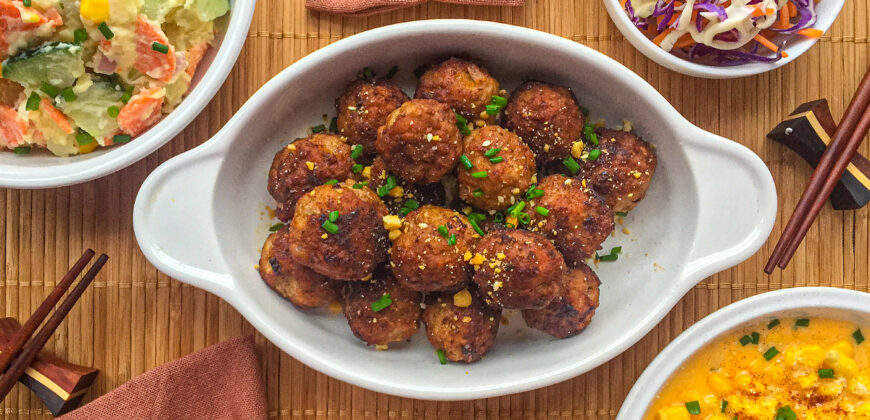
This easy Korean meatballs recipe makes a popular Korean street food snack called goji wanja that’s sold on skewers or toothpicks as fast food, served in Korean bars and pubs as drinking food (anju), as well as cooked and eaten in the home. These moist savoury meatballs can be doused in a sauce or brushed with a glaze.
If you’re a lover of meatballs – more meatball recipes here! – and a fan of Korean food, you’ll love this quick and easy Korean meatballs recipe for a much-loved Korean street food snack, goji wanja. Also made and eaten in the home, you’ll spot these meatballs on Korean pub and bar menus for anju or drinking food.
This Korean meatballs recipe is super versatile recipe, too. The juicy meatballs can be finished in the sauce, making for melt-in-the-mouth meatballs. Or you can add a tad more sugar and reduce the sauce down to a sticky glaze, which can be brushed on the meatballs. I prefer a firmer meatball and lighter sauce drizzled on the meatballs before serving.
My recipe makes enough meatballs for a relaxed meal for two if you serve it with a salad or a feast for four if you serve the meatballs with Korean corn cheese, Korean potato salad, this refreshing Korean cucumber salad, and Korean coleslaw. Eat leftover meatballs with my spicy Korean spicy ramen noodles.
For casual gatherings, you can double or triple the amount and poke skewers into the meatballs and serve them as finger food. Now let me tell you more about this easy Korean meatballs recipe for the Korean street food snack, goji wanja.
Korean Meatballs Recipe for the Popular Street Food Snack
We used to eat a lot of Korean food many years ago when Terence and I lived in Potts Point in inner city Sydney, my hometown. We mainly tucked into Korean barbecue on Friday and Saturday nights with groups of friends, while mid-week I’d often pick up take-away Korean japchae (glass noodles) on my way home from evening uni classes for a late dinner.
Ironically, we’ve eaten less Korean food since we’ve lived in Asia, despite Cambodia having a sizeable Korean expat population, young Cambodians being obsessed with all-things-Korean, from K-Pop to Korean movies and Korean food, and there being plenty of Korean restaurants, fast food franchises and casual eateries in Cambodia.
We have a lot of Korean noodle joints and street food spots in Siem Reap (selling meatballs just like these), but our favourite Korean restaurant is in the Cambodian capital, Phnom Penh. UWA Korean Street Food is a casual, white-walled minimalist eatery of the kind where you access the menu on your phone via a QR code and fill out your own order on a form.
UWA specialises in affordable, (not-so) ‘small’ plates (portions are super generous!) of Korean comfort food and street food and it’s super popular with Korean expats and young Cambodian couples, who seem to be able tuck away enough Korean fried chicken, fluffy pork belly bao, bibimbab, kimbap, bokkeumbap, and tteokbokki to feed a whole family.
Terence and I usually order just a few dishes in the smallest size, and even then we end up leaving loads of food. Perhaps because I’ve been cooking so much Russian food, pastas for my mum, and Middle Eastern food this year, but I’ve had cravings for Asian food, especially Korean food.

All of that is to explain why I’ve been cooking Korean food in recent days, starting with these Korean meatballs, Korean potato salad, and Korean cheese corn – just like they make it at my favourite Phnom Penh eatery. Today we’re tucking into leftover meatballs with noodles.
Tips to Making this Korean Meatballs Recipe
I only have a few tips to making this Korean meatballs recipe, as it really is easy and comes together quickly. I’ve adapted our recipe for Korean meatballs from a recipe in a Korean Tourism Association brochure I picked up at a stall at Campsie Food Festival in Sydney years ago.
It’s a simplified version of that Korean meatball recipe, as there are ingredients I can’t source. But one Korean ingredient that’s a must is the spicy Korean chilli paste called gochujang – even though I’ve listed it as optional! The reason I’ve done that is for those of you who don’t like spice. These are just as tasty without gochujang. Another option for chilli lovers are the Korean chilli flakes called gochugaru.
Korean cooks traditionally make many dishes with their hands, from salads to these meatballs, using their hands to combine the ingredients. By all means use a spoon if you prefer, but in this case you need to squeeze the mince mixture so it better holds together, and also to form the balls and rolls them between two hands.
A tip: wet your hands, so the mince doesn’t stick as much. Another tip: if the mixture is a little too wet, just add a little flour (or even bread crumbs) and combine well.

To form the meatballs, sprinkle a tray with flour, scoop out a generous teaspoonful of the mixture, squeezing it in your hand, then shape it into a 3cm-wide meatball. At home in Siem Reap, I usually weigh my meatballs, so the size is consistent, but I don’t have digital kitchen scales at Mum’s, but I when I get some I’ll add the weight here.
As I make the meatball, I pop it on the floured tray, but I wait until I’ve used up all the mince mixture before rolling the meatballs lightly to coat them in the flour, so that the meatballs don’t dry out.
When you fry the meatballs, make sure you don’t crowd the pan – you want to fry the meatballs, not steam them. I’m using a big deep fry pan these days, so I can do the whole lot in one batch. But if you want to use a smaller pan and therefore use less oil when you’re deep-frying, you’ll probably need to make these meatballs in two batches.
Another tip: use long tongs when you’re deep-frying the meatballs so you don’t burn yourself if it splatters.
Make the sauce in a small pan. You have some options here: some Korean recipes call for finishing the meatballs in the sauce. This will give you very moist melt-in-the-mouth meatballs. I think these are best for eating with rice or noodles.
Other recipes call for more sugar and reduce the sauce right down to create a glaze. Feel free to do that and use a silicon pastry brush or fibre pastry brush to brush the sauce onto the meatballs. I’m not a fan of a sticky glaze, but if you are, go for it. I prefer a sauce that falls somewhere in between, which I pour over the meatballs, which will soak it up.
A traditional garnish for these Korean meatballs is crushed peanuts and sliced spring onions/scallions, but sesame seeds and chives also work. Serve immediately – with toothpicks if you’re serving these as finger food.
Korean Meatballs Recipe

Equipment
Ingredients
- 125 g ground beef
- 125 g ground pork
- 2 spring onions - white ends only, finely diced
- 2 button mushrooms - finely diced
- 2 chives - finely chopped
- 1 egg yolk
- 1 tsp soy sauce
- 1 tsp sesame oil
- ½ tsp gochujang - optional, or to taste or another hot sauce
- ½ tsp garlic powder
- ½ tsp ground ginger
- ¼ tsp white pepper
- ¼ tsp salt
- 2 tbsp flour
- vegetable oil for frying
Sauce
- 2 tbsp Japanese soy sauce
- 2 tbsp rice wine vinegar
- 2 tsp sugar
- 1 garlic clove - minced
- 2 tbsp water - or more if needed
Instructions
- To a large mixing bowl, add all the meatball ingredients except the flour, and use wet hands to blend everything together well, squeezing the mixture. If it’s a little too wet, add a little flour and combine well.
- Sprinkle a tray with the flour. Scoop out a generous teaspoonful of the mixture, squeeze it in your hand, shape it into a 3cm-wide meatball, transfer it to the tray, and repeat until you’ve used up all the mixture. Roll the meatballs to lightly coat them in the flour.
- To a frying pan, pour in enough oil to shallow fry the meatballs, and heat the oil over medium-high until shimmering. Add the meatballs, ensuring they’re not crowded. As one side of the meatballs brown, use tongs to turn the meatballs to brown them all over. Once brown, transfer the meatballs to a serving dish. You may have to fry the meatballs in batches depending on the size of your pan so repeat if needed with the rest of the meatballs.
- To a small pan, add the sauce ingredients, heat over medium-high heat, stirring with a wooden spoon until the sauce has reduced, then pour it over the meatballs. If you prefer more of a glaze, add more sugar, then use a pastry brush to coat it on the meatballs.
- Sprinkle on your choice of garnish – either crushed peanuts or sesame seeds, or sliced spring onions (scallions) or chives – and serve immediately with toothpicks.
Notes
Please do let us know if you make our Korean meatballs recipe as we’d love to know how it turns out for you.