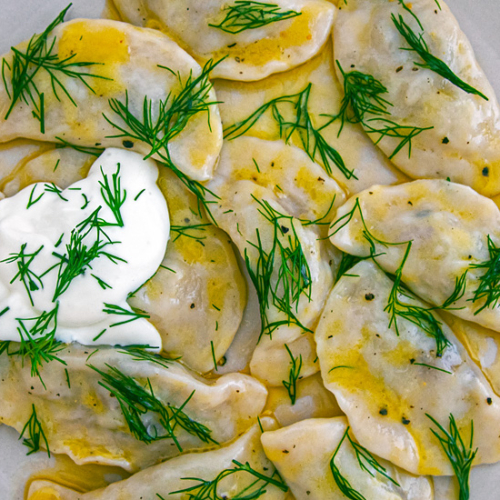
Russian Potato Vareniki Recipe
This traditional Russian Potato Vareniki Recipe makes half-moon shaped Russian dumplings filled with mashed potato and caramelised onion that are eaten with sour cream and fresh dill. My baboushka would make a big batch of these along with meat-filled pelmeni for family feasts. Boiled the first time they’re cooked, they’re fantastic fried the next day.
Servings: 50 Pieces
Calories: 40kcal
Ingredients
Dough
- 500 g All Purpose Flour
- 200 ml water
- 1 tsp of salt
Vareniki filling
- 1 tbsp neutral cooking oil
- 1 large white onion finely chopped
- 500 g potatoes
- 2 tsp salt
- 2 tsp pepper
Instructions
- Put your potatoes on to boil.
- While the potatoes are boiling, make the dough by pouring the flour onto your kitchen workspace into a mound. Poke a large hole in the centre and add a pinch of salt, then pour 200ml of water into the hole, and using your hands, start to combine. (If you prefer, you can do this in a mixing bowl instead of on the bench, bring it out of the bowl to knead, then return it to the bowl to let it rest.)
- Knead the dough for a few minutes. If it’s too dry, add more of the water; too wet, add a little more flour. Don’t over-knead. Once combined and you can form the dough into a ball, wrap it in cling wrap, and set it aside to rest for 30 minutes.
- Drain the potatoes and while they’re cooling, fry the finely chopped onion in cooking oil until it has browned and caramelised.
- Remove the potato skins and mash the potato, then add the caramelised onion, season with salt and pepper, combine well, and set aside.
- To prepare your vareniki casings, sprinkle your kitchen workspace with a little flour so that the dough doesn’t stick to the surface. Split your ball of dough into quarters and put a clean tea towel or cloth over the dough you’re not using.
- Use a rolling pin, roll a ball of dough out into a large oval shape to around 2mm thickness. Do not turn it over – the exterior can be dusted in flour, but not the interior.
- Use the rim of a glass (7cm diameter), turned upside down, to create the dumpling rounds. Begin at the top edge and work your way around and then into the centre, leaving no space between rounds. Twist the glass back and forth a few times if necessary to cut through the dough.
- Once you’re done, pull the leftover dough scraps away, and roll them all into a ball and pop that under the cloth with the rest of the dough. It shouldn’t, but if the dough feels dry, dampen the tea towel, or wrap each ball in cling wrap or aluminium foil.
- To fill your vareniki casings, scoop out some mashed potato mixture with a teaspoon, aiming for around 7gms per teaspoon. Place the mixture on the centre of the casing, and do this for each casing, to ensure they’re of equal size. Work quickly, though, so the casings don’t dry out.
- Holding one filled casing in your left hand, fold half over with your right hand, then starting at one end, pinch the sides together, working your way down to the other side until it’s completely sealed. If your dough rested and is nice and soft and smooth, it should seal easily.
- If it isn’t, pour some water in a small dish, dip your pointer finger into the dish, and rub a little water (not too much) along the interior edge and that should do the trick. You should have a dumpling that is half-moon shaped. Lay it on a tray lightly dusted with flour. Repeat.
- Bring a big pot of water to a boil, throw in a pinch of salt, turn the heat down a little to a gentle boil (so as not to tear the casings apart), then carefully slide the dumplings into the water and turn up the heat a little.
- After the dumplings rise to the surface, give them 2-3 minutes, then scoop them out and pop them into a casserole dish with a couple of generous chunks of quality butter. When they’re all in the dish, gently move it from side to side to ensure the vareniki are completely covered in butter.
- Take another ball of dough and repeat that process to make another batch. Any leftover vareniki can be fried the next day. Alternatively, you can keep balls of dough wrapped in cling wrap in the fridge overnight and make more batches the next day. You can also freeze finished batches by freezing them on their tray first, then when frozen put them into ziplock bags.
- Serve vareniki in a casserole dish at the centre of the table with a big bowl of sour cream sprinkled with fresh dill and a selection of other Russian dishes to be shared family-style, or portion out on individual plates, plopping a dollop of sour cream and sprinkle of dill on each plate.